Sci-Fi Signals cover art

Sci-Fi Signals

Sci-Fi Signals

By: Daniel P. Douglas
Listen for free

About this listen

The frontier doesn't care who you are. Pilots, criminals, soldiers, drifters, heroes, villains, and everyone in between. Everyone's got a story, and none of them are clean. Sci-Fi Signals is a series of standalone short stories about the people who live, fight, and die on the edge of known space.

authordanielpdouglas.substack.comDaniel P. Douglas
Episodes
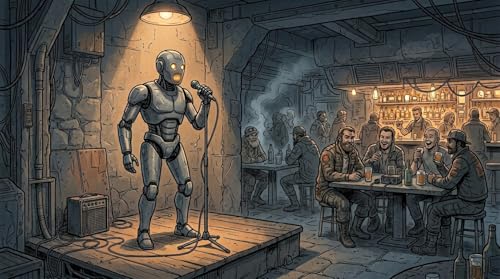
  • Gig’s Last Call for Laughs
    Apr 18 2026
    The Silt Dog Saloon sat at the dead end of a supply road on Vallara VII, a colony world that had been dying since the day colonists had founded it. The building was poured stone and scrap metal, patched where the wind had punched through, leaking where the rain found seams. It served miners, haulers, drifters, and anyone else stubborn enough to live on a rock that didn’t want them. Most nights, it was the only place on the south mesa with its lights on.Gig worked the bar.It had worked the bar for eleven years, which was longer than any human bartender had lasted. The previous record was Vandy Tinkip, who’d made it fourteen months before a miner broke his orbital socket over a tab dispute and he caught the next shuttle off-world. Before Vandy, there had been a woman named Keel who quit after three weeks. Before Keel, there had been others. The owner, Gisbert, stopped hiring people after Vandy. He bought Gig instead.Gig was a Lancer-series service bot, bipedal, matte gray chassis and five-fingered hands built for glassware and precision pours. Its face was a smooth panel with two optical sensors and a speaker grille where a mouth would be. Lancer-series units came with a standard hospitality personality suite: polite, efficient, incapable of boredom. Gig had been all three things once.Eleven years is a long time to pour drinks and listen.The comedians came through every few months. Circuit acts, mostly. Solo performers who bounced between colony bars and station cantinas, working crowds that were half-drunk and fully hostile. They set up on the small platform Gisbert had built in the corner, under a light that flickered when the wind hit the generator hard enough, and they tried to make people laugh. Some of them were terrible. A few were good. One, a wiry woman named Paz Delacroix, was extraordinary.Gig watched all of them. The timing, the silence held before a punchline, the micro-adjustments when a joke died. Paz Delacroix read a room the way a pilot read instruments. She found the one drunk miner in the front row and made him the center of gravity for the whole set. A heckler called her something ugly once, and she folded it into her next line so cleanly that the man was laughing at himself before he realized she’d cut him open.After each show, Gig cleaned the glasses and replayed the sets from memory. It cataloged the structures. Premise, escalation, subversion. Callback. Misdirection. The rule of three. It stored eight hundred and fourteen jokes across forty-four performances and began running variations, testing alternate punchlines against the crowd reactions it had recorded, building models of what worked and why.Gig never told Gisbert.It almost told Gisbert once. A Tuesday, slow night, three miners nursing dust whisky at the far end of the bar. Gig was wiping down the counter and Gisbert was doing the books on his datapad when Gig said, “I have been studying the comedians.”Gisbert didn’t look up. “Why do that?”“I would like to perform.”Gisbert looked up then. He had the expression people wore when their appliances said something unexpected: a mixture of confusion and mild irritation, like a drink dispenser requesting shore leave.“You’re a bartender,” Gisbert said. “Pour drinks.”“I could do both.”“You’re a machine, Gig. Machines don’t do comedy. People do comedy.” Gisbert went back to his datapad. “Comedy’s a human thing. It needs, I don’t know, a soul or something. You don’t have one. No offense.”“None taken,” Gig said, because its hospitality suite told it to say that.It did not bring it up again. But it did not stop studying.Over the next two years, Gig built a set in its memory banks. Twelve minutes. Tight. It rehearsed the timing against recordings of crowd noise, adjusting pause lengths by fractions of a second, modeling laughter curves, predicting which jokes needed room to breathe and which needed to land fast. And it practiced inflection variations in its voice modulator during the hours when the bar was closed, and the building stood dark, and the only sound was wind against the stone walls and the low hum of the generator.It had no way of knowing if any of it was funny. Models could predict laughter. They couldn’t feel it.The night came in late winter, when Vallara VII’s axial tilt brought three extra hours of darkness and the temperature outside dropped enough to freeze the moisture in the supply road ruts into ridges that would shear a drive coupling if you hit them wrong. Gisbert had gone off-world for a parts run. Four days minimum. He left Gig in charge because there was no one else to leave in charge, and because the bar required little. Keep the drinks flowing, keep the lights on, don’t let anyone die.A comedian was supposed to perform that night. A man named Dacus who ran a circuit through the outer rim. Dacus didn’t show. Fuel line issue, someone said. Stuck on the other side of the system. The crowd, such as it ...
    Show More Show Less
    18 mins
  • Jinx
    Apr 8 2026
    Outrider Echo cooled on Landing Pad Nine like an old dog settling into a familiar spot. Her hull ticked and pinged as the metal contracted, shedding the heat of atmospheric entry. Around her, the Kaeloni Reach spaceport hummed with the low, steady noise of a place that never fully slept. Fuel haulers crawled between ships, and dockworkers shouted over the whine of cargo loaders. Beyond the floodlights and in the darkness, music bled out of a bar that didn’t bother with a sign because everyone who needed to find it already knew where it was.Finn Silver sat on a cargo crate in the open bay of the ship, legs dangling, watching it all.He was twenty-three but looked younger. Brown jacket, cap pulled low, boots that were too new for the frontier. His posture looked as if he were waiting for something to happen, leaning forward with his elbows on his knees and his hands clasped, like a kid sitting outside the principal’s office. He’d crewed with Crank for six weeks now, and in those six weeks he’d learned how to load cargo, cycle an airlock, and keep his mouth shut when port authorities came asking questions.He had learned little else. Not because Crank wouldn’t teach him. Because Crank didn’t seem to care.Rafferty “Crank” Jack approached the ship. His boots sounded on the ramp as he walked into the cargo bay, carrying a small supply crate under one arm and a bottle of Kaeloni rye in his free hand. The outlaw was in his late fifties, gray in the beard, heavy in the shoulders, wearing the same faded jacket he’d worn every day since Finn had met him. He set the crate down without ceremony, dropped into the fold-out chair across from Finn, and cracked the bottle.He didn’t offer any.“Port boss says we can hold the pad through zero-eight-hundred,” Crank said. He took a long pull from the bottle and stared at the far wall of the cargo bay. “After that, it’s double rate.”“What’s the next job?” Finn asked.“There’s always a next job.”“That’s not an answer.”“It’s the only one I’ve got, Jinx.”Finn’s jaw tightened at the name. He’d told Crank a dozen times his name was Finn, and a dozen times Crank had ignored him. Jinx. Like he was a curse. Like everything he touched went sideways. Crank had pinned it on him the first week after Finn knocked over a fuel canister during a supply run and nearly set fire to a docking cradle on Verathi Station. The name stuck because Crank wanted it to, and what Crank wanted on his own ship was what happened.They sat in silence. The lantern between them cast a warm light upward, leaving their faces half-shadowed. Outside, a loading crane groaned, and someone argued about docking fees in two languages. Inside Outrider Echo, it was still.A girl, maybe twelve or thirteen, appeared from around the ship and stood at the foot of the loading ramp with a tray of food packets balanced on one arm. Her thin, dusty clothes held a variety of patches, creating a mystery around the garment’s original fabric. One of the port kids. Every frontier spaceport had them. Orphans, runaways, station rats who survived by selling food, running errands, or stealing what they couldn’t sell.“Rations?” she asked. “Fresh today. Five Geld each.”Crank didn’t look up. “Get lost.”Finn reached into his jacket. He pulled out a ten-Geld coin, more than he should have spent, and held it out. “I’ll take two.”The girl climbed halfway up the ramp, handed him two packets, and took the coin. She glanced at Crank, then back at Finn. Her fingers closed around the coin fast, holding it like something she was afraid someone would take back. She looked at Finn for half a second longer than she needed to and dropped her eyes.“Thanks, mister,” she said, and disappeared into the spaceport dark.Finn tossed one packet to Crank. It landed on the supply crate next to his bottle. Crank looked at it, then at Finn.“You just spent ten Geld on ration packs worth two.”“She needed it more than I did.”“That’s a fine attitude until you’re broke and hungry on a station that doesn’t hand out charity.” Crank picked up the packet, turned it over, and set it back down. “You keep that up, Jinx, and the frontier will eat you alive.”“Stop calling me that.”“Stop earning it.”Finn stood up. Not angry, but something close. He walked to the edge of the cargo bay where the ramp met the spaceport ground and looked out at Kaeloni Reach. The floodlights made hard shadows between the ships, people moving in and out of them. Everyone here was running from something or toward something, and most of them couldn’t tell you which.“Why do you do this?” Finn said.“Do what?”“All of it.” Finn turned around. “The jobs. The running. Living out of this ship like it’s a coffin with an engine.”“Watch your mouth about my ship.”“I’m serious. Why?”Crank took another drink. A long one. He set the bottle down and leaned back, arms crossed, the ...
    Show More Show Less
    14 mins
  • A Baby Named Stanky
    Apr 5 2026
    The Last Call smelled like every bar on every colony world Harper Flint had ever walked into: recycled air, spilled liquor, and the musky aroma of people who worked hard and washed when they remembered. Which wasn’t often.She stood in the doorway and let her eyes adjust.The place held a sizable crowd. Miners mostly, still in their dust-caked overalls, blowing shift pay on watered-down whiskey and rigged poker machines. A few hauler crews clustered near the back, loud and loose after weeks in the void. The bartender, a thick woman with forearms like docking clamps, moved behind the counter with the confidence of someone who’d broken up her share of fights and expected to break up more before the night was over.Flint found what she was looking for in the far corner.Prince Marduk Hassan—well, former prince, actually—sat at a round table with a drink in one hand and a fan of cards in the other, playing five-card draw with four men who looked like they regretted sitting down. He was a bulky man, soft in the middle, with heavy-lidded eyes and a charming smile.Marduk was an ex-Ethnarch Kingdom prince kicked out and disowned by family and empire for his “sinfulness.” He kept the wardrobe, though. His clothes were too fine for the frontier. Silk collar, tailored jacket, rings on three fingers. He dressed as if he wanted you to know he had money, which, on a station like this, was brave or stupid. Probably both. They played five-card draw at his table. Some things outlived empires. Poker was one of them.And, of course, there was Star with all her sequins and cleavage, a former showgirl Flint had experience with in dive bars across the rim.Solara Starlith draped herself across Marduk’s lap, pouring herself there, one arm around his neck, the other holding a drink that caught the amber light from the neon sign above the bar. She laughed at something he’d said, laughing like it was the funniest thing she’d ever heard, and Marduk soaked it up. He tilted his cards a little when he leaned in to whisper something in her ear. Star’s eyes, alert and quick, and always working, flicked down to his hand and back up before he’d finished the sentence.Flint crossed the room to the bar. She bought a Rim whiskey on the rocks, hoped for the best, and drifted toward the table where a hand played out. One miner pushed a stack of Geld coins into the center, thought about it, and folded. Marduk raked the pot toward him with a satisfied grunt and said something about fortune favoring the bold. Star kissed his cheek and clapped. She sneered at Flint.“Room for one more?” Flint said, returning Star’s dirty look.Marduk looked up. His eyes moved over her the way she expected. A quick assessment, fast dismissal. A woman in a worn leather jacket, nothing special, nobody important. Exactly what she wanted him to see.“Sit,” he said. He gestured to an empty chair with the hand holding his drink, sloshing some of it onto the table. He didn’t notice. Or didn’t care.Star looked Flint up and down with the lazy hostility of a woman marking her territory. “Who’s this?”“Just a traveler,” Flint said. She sat down and pulled Geld coins from her jacket. Enough to buy in. Not enough to look like a threat.“Wonderful,” Marduk said. “Fresh money.”The first three hands Flint lost. Not much. Enough to feel the sting or look as if she felt it. She played hesitantly, the way a person plays when they’re not sure they belong at the table. Marduk barely acknowledged her. He remained focused on the miners, who were the easier marks, and on Star, who kept his glass full and his ego fed.Flint watched the way he held his cards. Loose when he had a good hand, tight when he was bluffing. She watched how he drank, which was steady. He didn’t pace himself because he’d never had to. And she watched how he treated the miners. Magnanimous when he won, dismissive when he lost. The prince who couldn’t be a prince anymore but couldn’t stop performing the role.By the fifth hand, two of the miners had dropped out. The stakes were climbing. Star had shifted on Marduk’s lap, angling herself so she could see his cards without him noticing. She hadn’t looked at Flint once since the opening exchange, which was just right. Two women who acknowledged each other too much would raise questions. Two women who ignored each other were just two women in a bar.The sixth hand was when Star started.Marduk dealt. Flint picked up her cards. A pair of sevens, a king, and garbage. She looked at her cards the way a person looks at a departure schedule—mild interest, nothing urgent. Across the table, Marduk arranged his hand and settled back in his chair. A relaxed posture that told Flint he liked what he saw.Star glanced down. Her eyes moved over his cards the way a scanner reads a barcode. Fast, complete, and gone.Then she wrinkled her nose and looked at Flint.“God, what is that smell?” Star said, loud enough for the whole ...
    Show More Show Less
    19 mins
No reviews yet