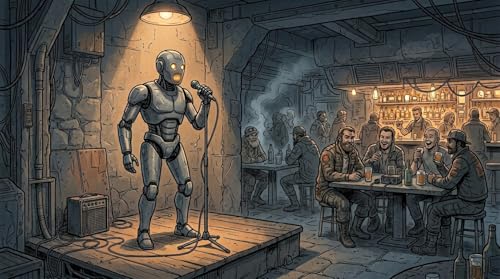
Gig’s Last Call for Laughs cover art

Gig’s Last Call for Laughs

Gig’s Last Call for Laughs

Listen for free

View show details

About this listen

The Silt Dog Saloon sat at the dead end of a supply road on Vallara VII, a colony world that had been dying since the day colonists had founded it. The building was poured stone and scrap metal, patched where the wind had punched through, leaking where the rain found seams. It served miners, haulers, drifters, and anyone else stubborn enough to live on a rock that didn’t want them. Most nights, it was the only place on the south mesa with its lights on.Gig worked the bar.It had worked the bar for eleven years, which was longer than any human bartender had lasted. The previous record was Vandy Tinkip, who’d made it fourteen months before a miner broke his orbital socket over a tab dispute and he caught the next shuttle off-world. Before Vandy, there had been a woman named Keel who quit after three weeks. Before Keel, there had been others. The owner, Gisbert, stopped hiring people after Vandy. He bought Gig instead.Gig was a Lancer-series service bot, bipedal, matte gray chassis and five-fingered hands built for glassware and precision pours. Its face was a smooth panel with two optical sensors and a speaker grille where a mouth would be. Lancer-series units came with a standard hospitality personality suite: polite, efficient, incapable of boredom. Gig had been all three things once.Eleven years is a long time to pour drinks and listen.The comedians came through every few months. Circuit acts, mostly. Solo performers who bounced between colony bars and station cantinas, working crowds that were half-drunk and fully hostile. They set up on the small platform Gisbert had built in the corner, under a light that flickered when the wind hit the generator hard enough, and they tried to make people laugh. Some of them were terrible. A few were good. One, a wiry woman named Paz Delacroix, was extraordinary.Gig watched all of them. The timing, the silence held before a punchline, the micro-adjustments when a joke died. Paz Delacroix read a room the way a pilot read instruments. She found the one drunk miner in the front row and made him the center of gravity for the whole set. A heckler called her something ugly once, and she folded it into her next line so cleanly that the man was laughing at himself before he realized she’d cut him open.After each show, Gig cleaned the glasses and replayed the sets from memory. It cataloged the structures. Premise, escalation, subversion. Callback. Misdirection. The rule of three. It stored eight hundred and fourteen jokes across forty-four performances and began running variations, testing alternate punchlines against the crowd reactions it had recorded, building models of what worked and why.Gig never told Gisbert.It almost told Gisbert once. A Tuesday, slow night, three miners nursing dust whisky at the far end of the bar. Gig was wiping down the counter and Gisbert was doing the books on his datapad when Gig said, “I have been studying the comedians.”Gisbert didn’t look up. “Why do that?”“I would like to perform.”Gisbert looked up then. He had the expression people wore when their appliances said something unexpected: a mixture of confusion and mild irritation, like a drink dispenser requesting shore leave.“You’re a bartender,” Gisbert said. “Pour drinks.”“I could do both.”“You’re a machine, Gig. Machines don’t do comedy. People do comedy.” Gisbert went back to his datapad. “Comedy’s a human thing. It needs, I don’t know, a soul or something. You don’t have one. No offense.”“None taken,” Gig said, because its hospitality suite told it to say that.It did not bring it up again. But it did not stop studying.Over the next two years, Gig built a set in its memory banks. Twelve minutes. Tight. It rehearsed the timing against recordings of crowd noise, adjusting pause lengths by fractions of a second, modeling laughter curves, predicting which jokes needed room to breathe and which needed to land fast. And it practiced inflection variations in its voice modulator during the hours when the bar was closed, and the building stood dark, and the only sound was wind against the stone walls and the low hum of the generator.It had no way of knowing if any of it was funny. Models could predict laughter. They couldn’t feel it.The night came in late winter, when Vallara VII’s axial tilt brought three extra hours of darkness and the temperature outside dropped enough to freeze the moisture in the supply road ruts into ridges that would shear a drive coupling if you hit them wrong. Gisbert had gone off-world for a parts run. Four days minimum. He left Gig in charge because there was no one else to leave in charge, and because the bar required little. Keep the drinks flowing, keep the lights on, don’t let anyone die.A comedian was supposed to perform that night. A man named Dacus who ran a circuit through the outer rim. Dacus didn’t show. Fuel line issue, someone said. Stuck on the other side of the system. The crowd, such as it ...
No reviews yet