The Pragmatic Engineer cover art

The Pragmatic Engineer

The Pragmatic Engineer

By: Gergely Orosz
Listen for free

Software engineering at Big Tech and startups, from the inside. Deepdives with experienced engineers and tech professionals who share their hard-earned lessons, interesting stories and advice they have on building software. Especially relevant for software engineers and engineering leaders: useful for those working in tech.

newsletter.pragmaticengineer.comGergely Orosz
Politics & Government
Episodes
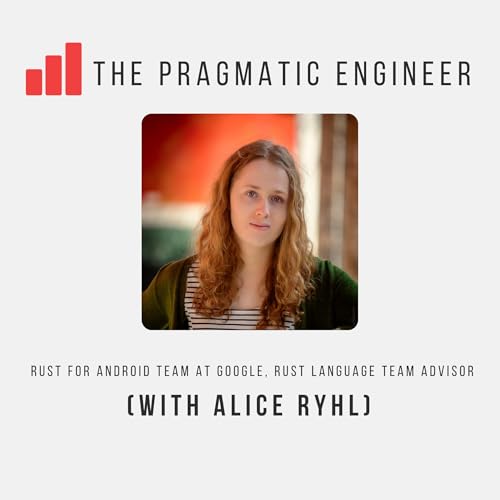
  • Why Rust is different, with Alice Ryhl
    May 20 2026

    Brought to You By:

    Antithesis – verify your system’s correctness without human review or traditional integration tests – and avoid bugs or outages.

    Sentry⁠ – application monitoring software considered “not bad” by millions of developers

    • ⁠Craft Conference⁠: join Gergely, Kent Beck, Hillel Wayne and others at the conference dedicated to the art and science of software delivery craft.

    Rust is one of the most admired programming languages around – and also one of the hardest to learn. What makes developers stick with it?

    In this episode of The Pragmatic Engineer Podcast, I sit down with Alice Ryhl, a software engineer on Google’s Android Rust team, and a core maintainer of Tokio, which is the most widely-used async runtime in Rust.

    We discuss what makes Rust different from other languages like TypeScript, Go, and C++, and why so many developers say that “once it compiles, it works.” We go deep into memory safety, ownership, borrowing, unsafe Rust, and Cargo.

    We also cover how Rust is governed by RFCs, feature flags, its six-week release cycle, how engineers get paid to work on the language, and also look into how Rust’s use inside the Linux kernel is progressing.

    Timestamps

    (00:00) Intro

    (04:09) Tokio: an overview

    (05:11) What Alice likes about Rust

    (12:48) Rust for TypeScript engineers

    (13:51) Moving from C++ to Rust

    (14:34) Memory safety

    (18:12) Garbage collection tradeoffs

    (21:46) Ownership, references, and borrowing

    (26:59) Unsafe in Rust

    (31:21) Crates and Cargo

    (35:55) Language design and RFCs

    (43:02) Building new features

    (46:30) Editions vs. versions

    (49:47) Getting paid to work on Rust

    (51:27) Contributing to Rust

    (53:03) Rust in the Linux kernel

    (55:45) AI use cases for Rust

    (1:01:35) Learning Rust

    (1:03:54) Book recommendation

    The Pragmatic Engineer deepdives relevant for this episode:

    The past and future of modern backend practices

    How Kotlin was built with Andrey Breslav

    How Swift was built with Chris Lattner

    How Linux is built with Greg KH

    Production and marketing by ⁠⁠⁠⁠⁠⁠⁠⁠https://penname.co/⁠⁠⁠⁠⁠⁠⁠⁠. For inquiries about sponsoring the podcast, email podcast@pragmaticengineer.com.


    Get full access to The Pragmatic Engineer at newsletter.pragmaticengineer.com/subscribe
    Show More Show Less
    1 hr and 5 mins
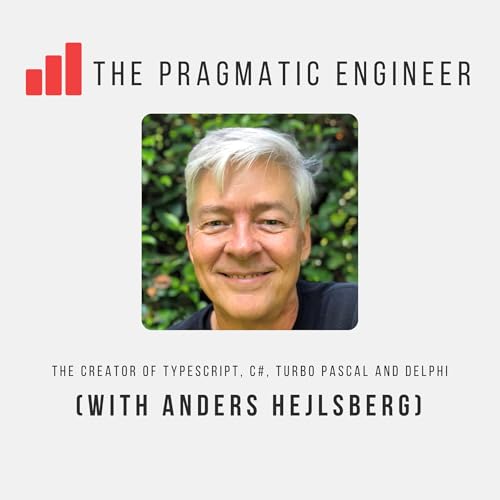
  • TypeScript, C# and Turbo Pascal with Anders Hejlsberg
    May 13 2026

    Brought to You By:

    Antithesis – verify your system’s correctness without human review or traditional integration tests – and avoid bugs or outages.

    WorkOS – Everything you need to make your app enterprise ready.

    turbopuffer – a vector and full-text search engine built on object storage. It’s fast, cheap, and extremely scalable.

    Anders Hejlsberg is a living legend and one of the most influential programming language designers of all time. He created Turbo Pascal, Delphi, C#, and also TypeScript. As well as that, he spent nearly a decade at the pioneering dev tools company, Borland, and is now in his 30th year of working at Microsoft, where he’s a Technical Fellow.

    In this episode, we discuss what it takes to build programming languages that developers love to use, and trace his career from writing his first compiler to creating Turbo Pascal and Delphi, and helping to pioneer modern software development through C# and TypeScript.

    Anders details how C# was designed by a small group of experienced language designers who met a few hours each week, and he explains why tooling was just as important as the language for TypeScript’s success, and what he has learned from building languages which stay relevant for decades.

    We also look into how Anders uses AI today, which language features suit AI-assisted development, and what he thinks is changing in the craft of software engineering as developers move further away from writing code line by line.

    Timestamps

    (00:00) Intro

    (02:48) How Anders got into programming

    (05:40) Building his first compiler

    (07:44) Turbo Pascal

    (12:25) Delphi

    (14:53) Joining Microsoft

    (19:41) Building C#

    (29:11) Async/await

    (34:01) The rise of JavaScript

    (37:52) Building TypeScript

    (42:58) How the TypeScript compiler works

    (48:30) JavaScript’s strengths and weaknesses

    (52:18) How Anders uses AI

    (56:03) What language features work well with AI

    (1:02:49) How software craftsmanship is changing

    (1:07:49) Performance and efficiency

    (1:09:29) Anders’ tool stack

    (1:11:30) A 30-year career at Microsoft

    (1:13:40) Book recommendation

    The Pragmatic Engineer deepdives relevant for this episode:

    • Microsoft’s developer tools roots

    • 50 Years of Microsoft and developer tools with Scott Guthrie

    • How Linux is built with Greg Kroah-Hartman

    • How will AI change operating systems? Part 1: Ubuntu and Linux

    • How Uber uses AI for development: inside look

    Production and marketing by ⁠⁠⁠⁠⁠⁠⁠⁠https://penname.co/⁠⁠⁠⁠⁠⁠⁠⁠. For inquiries about sponsoring the podcast, email podcast@pragmaticengineer.com.


    Get full access to The Pragmatic Engineer at newsletter.pragmaticengineer.com/subscribe
    Show More Show Less
    1 hr and 15 mins
  • Building Pi, and what makes self-modifying software so fascinating
    Apr 29 2026

    Brought to You By:

    Statsig — ⁠ The unified platform for flags, analytics, experiments, and more.

    Sonar – The makers of SonarQube, the industry standard for automated code review

    WorkOS – Everything you need to make your app enterprise ready.

    Mario Zechner is the creator of Pi, a minimalist, self-modifying AI coding agent, that is the foundation upon which OpenClaw (created by Peter Steinberger) is built. Meanwhile, Armin Ronacher is the creator of Flask, and a longtime user of Pi. The pair are also friends.

    I sat down with Mario and Armin for the latest episode of the Pragmatic Engineer Podcast for an interesting conversation about AI and their reservations about it – even though both are heavily invested in building AI-powered tools.

    Mario explains why he built Pi, and gives his take on why it has become so popular. Armin walks us through how he uses AI tools, including building a game with Pi, and why he always puts human judgment firmly at the heart of his approach.

    We cover the risks of over-automation, the limits of agentic workflows, and why strong engineers with informed judgment still matter. We also get into the challenges of working with code written by non-engineers, and whether open source can withstand a tidal wave of agent-generated code.

    Timestamps

    (00:00) Intro

    (07:30) How Mario, Armin, and Peter Steinberger met(15:15) How 30 dev teams use AI agents: learnings

    (21:50) The importance of judgment

    (24:26) Challenges when non-engineers write code

    (28:30) Downsides of over-automation

    (32:18) Pi

    (48:09) OpenClaw + Pi

    (50:54) “Clankers”

    (57:32) Open source and AI

    (1:00:22) Complexity as the enemy

    (1:02:50) Building an AI-native startup

    (1:11:52) “Slow the F down”

    (1:16:40) MCPs vs. CLI

    (1:25:03) Predictions and staying up to date

    The Pragmatic Engineer deepdives relevant for this episode:

    • The impact of AI on software engineers in 2026: key trends

    • Cycles of disruption in the tech industry

    • The AI engineering stack

    • The creator of OpenClaw: "I ship code that I don't read"

    • What is inference engineering? Deepdive

    Production and marketing by ⁠⁠⁠⁠⁠⁠⁠⁠https://penname.co/⁠⁠⁠⁠⁠⁠⁠⁠. For inquiries about sponsoring the podcast, email podcast@pragmaticengineer.com.


    Get full access to The Pragmatic Engineer at newsletter.pragmaticengineer.com/subscribe
    Show More Show Less
    1 hr and 33 mins
adbl_web_anon_alc_button_suppression_c
No reviews yet