Episodes

  • Be the Bank, Not the Borrower: 10% - 12% Fixed Returns via Private Lending
    Jun 3 2026

    SteelPoint Capital was built on a simple premise: real estate investors need fast, reliable financing. Traditional lenders take weeks or months and come with red tape. Hard money lenders understand the asset and the operator.


    Here's what that means in practice: 10-12% fixed returns paid monthly (or compounded), 24-48 hour underwriting, first lien position on every deal, and a lender who's actually a real estate investor themselves. After six years and zero defaults, SteelPoint's model works because TJ and his partners won't lend on a deal they wouldn't take over if the borrower defaulted.


    But there's a deeper story here about why discipline, transparency, and a belief in something bigger than yourself actually compounds into better business. This episode covers both the mechanics of deploying capital into hard money funds and the character required to do it with integrity.

    Show More Show Less
    38 mins
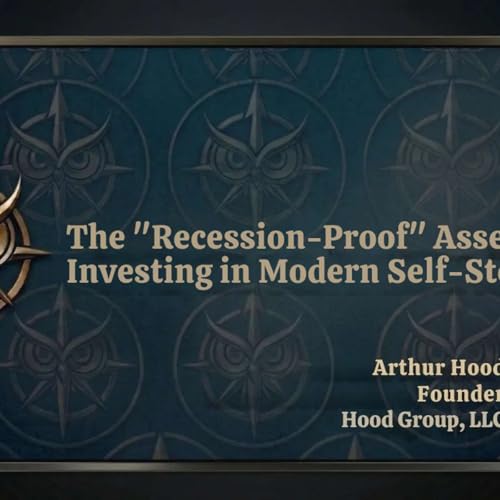
  • The Recession Proof Asset Class - Investing in Modern Self Storage
    May 28 2026
    Self storage has historically gotten a bad rep for being on the low end of real estate holdings, and while there are still more mom and pop highway storage facilities than ever, professional real estate investors recognize how partnering with operators in ground up self storage development present a bounty of opportunity for interested real estate investors. In this discussion, we cover the finer details and important questions to consider when rating this asset class against othersonsite with my good friend Arthur Hood.What's happening, Arthur?Not a lot. Good morning.I appreciate you going to the extreme trouble that you've gone to to create this opportunity for you and I to speak to one another.That was easy.It was easy.I already have the office, soyou know, we got the space. We've got the opportunity. And we definitely havethe topic today. But Arthur, before weget into the topic, I want to frame theconversation for you around this avatarthat we've created named Stuart. Stuartis a character that we dreamt up torepresent the investors that are mostlikely watching this program today. Andmost of them listening have built somewealth in the stock market, but they'vegot capital gains. They definitely havetax exposure. and they're starting toask a very basic, simple, but incrediblyimportant question. Where does my moneygo next? So, today we're going toexplore an asset class that you are justan absolute expert at, and it's quietlyoutperformed like almost every otherreal estate sector for decades. It'sself- storage. So, Arthur, man, likeyou've structured more money in thesekinds of transactions than I can evenkeep track of. Do you have you keep arunning total ofI I started to look at it one day. Ithink just over between lifetime oftransactions probably just over abillion dollars.There you go. There you have it. So wewe'll just clarify that was a B billionover a billion dollars.Not a million.So that's industries but yes.So let me let me just ask you like so wesaid right like this this group ofpeople they're sitting on a stack ofRSUs right they've got the opportunityreally to create some leverage from theincome that they've created that'slargely sitting dormant sowe've in the capital shift what we talkabout a lot is this idea of needing tochange the way you think so that you canchange the way that you invest. So fromyour perspective when people arestarting to explore real estate as aninvestment vehicle like what's the firstbig mental shift that they need to make?Uh the the the first big mental shiftanyone needs to make especiallyswitching to a real estate investment isthat it's not a true liquid investment.There is a somewhat of a cost to get in,cost to get out as far as selling transor selling a property, buying aproperty, but long-term you're going toget depreciation, the ability to useleverage, which you really can't use inthe stock market unless we get intoleverage and a bunch of high riskinvolved in that, right? So you can do those items is thebiggest shift is if you've got a milliondollars in stocks, if you want a milliondollars in cash, you can have a milliondollars in cash the next day wired toyour bank account by day two. You can'treally do that with real estate.However, you can still get liquidity,but you have to borrow against your realestate. But then that's a that's atax-free transaction.And that, ladies and gentlemen, is whatmany of you are after. So, if thatcatches your attention, you're going towant to pay close attention to the restof what we're going to talk about today.So, a lot of times, uh, Arthur Stewartas a character, he's got a mentalconstruct that he needs to break downbefore he or she can really make thischange that you're describing. So, whatdo you think is the one big belief thatinvestors are stuck with that keeps themrooted in the stock market and reallynot considering what we're talkingabout? I think the one of the thingsthat keeps people rooted in the stockmarket is just the ease. It's click of abutton. They don't have to think or doanything. Real estate seems complicatedfrom the outside if you've never done itbefore. However, for me, I'm a lot morecomfortable with real estate. It's ahard asset. I can touch it. I can feelit. Um, regardless of what happens tothe US dollar, it will be paid for insome form or some currency. So, if thedollar was to ever just crash and burn,real estate will trade in some form of acurrency, gold, it doesn't matter, butit'll it'll maintain its value.Amen. And if you haven't givenconsideration to that thought, there's afoundational aspect for you to reallyspend some time thinking about uhputting into your favorite AI engine toreally spend some time in self-discoveryaround what this process might look foryou, but look like for you, but there'sdefinitely something to be had when itcomes to this. All right. So, myth isbusted, but let's talk about the actualasset class of self- storage itselfbecauseI've I've watched some of your othercontent, you have some ...
    Show More Show Less
    41 mins
  • The Only Truly Passive Real Estate Asset: Triple Net (NNN) Leases
    May 28 2026
    You know recurring revenue. You've sold it, pitched it, and fought for it every quarter. But what if you could own it? Triple Net Leases — known in the industry as NNN properties — are the commercial real estate equivalent of a contract that auto-renews, where the tenant handles the overhead and you collect the margin. No midnight maintenance calls. No chasing down repairs. Just predictable, long-term cash flow backed by national tenants with serious balance sheets.In this episode of The Capital Shift, NNN specialist Tom Rauen breaks down an asset class that most high earners have never considered — not because it's too complicated, but because nobody ever explained it in plain language. If you've been stacking W-2 income and wondering how to make it work harder without adding another job to your plate, this conversation is for you. In this episode:What a Triple Net Lease actually is — in plain EnglishWhy the tenant pays taxes, insurance, and maintenance (and why they're okay with that)How to evaluate a deal like an investor, not a landlordThe tenant creditworthiness question that separates good deals from great onesWhat high-income earners get wrong when they first enter this space🔔 Subscribe and hit the bell — new episodes drop regularly on The Capital Shift.Show Notes:which is the overarching premise of thecapital shift program, Tom Rowan, whichis this notion of as you are moresuccessful over the course of yourcareer, you have more resources than youmay have had when you first started. Andso consequently as your resources growand improve your thinking has to changefrom being a capital accumulator tobeing a capital deployer. As you aregoing through that metamorphosis, youactually are going through a bit of anidentity change in the process. So hencethe name the capital shift program. Sowelcome Tom. Happy to have you.>> Yes, glad to be here. So you want totell all the stewards out there a littlebit about Tom and your background andhow we found ourselves on this happyprogram today?>> Yeah, for sure. So I found it 1800t-shirts 20 years ago right out ofcollege. And so that's been my primaryjob as a a small business owner, as anentrepreneur, uh growing that businessnow to 40 employees and you know prettypretty full staff. And during thatprocess, as we were continuing to buildthe business, we were running into a lotof problems entrepreneurs have is um wewere making great money, but the tax manwould come knocking out the door. So, Iknew, you know, a lot of very wealthypeople use real estate as a vehicle tocreate passive income. And the otherpart was like as a business owner,entrepreneur, like I wasn't sure whatretirement looked like, whether that wasan age or money amount or something. AndI wanted to have that diversification onhand to you know kind of have a backstop I I guess you could say but thenalso to you know be earning some passiveincome um you know besides that andbuilding some wealth in the background.So we started investing in commercialreal estate primarily triple net leasefocused and so that is big names uh soour tenants are like Starbucks andArby's and Applebee's and nationalfranchises with 10 to 25 year leases andthe reason we focus on that asset classis because as like a full-time businessowner you know no different than someoneelse that has a full-time job um Ididn't have the time uh to dedicate todealing with tenants and toilets and allthis other stuff. And I'm not like ahandy dude. So, I can't I'm I can fixmaybe a few things, but I'm not really.So, I didn't want to like be fixingstuff and having to like, you know, dealwith like I don't even like to fix stuffaround our own house, let alone somebodyelse messing it up, right? So that's howwe found this asset class and it'sabsolutely phenomenal asset classbecause I truly believe it's the onlypassive asset class that's out there.The rest of them are actually a lot morework. Um this is the only true one thatyou can set it and forget it and youknow there's there's not all these otherthings going on. So that's that's why welove this asset class. It worked outreally well because we could build ourlifestyle around it, whether that's withwork or with family or traveling andeverything else. And as we look towardsthe future of, you know, retirement andthings like that, this asset class stilloffers all that freedom and flexibility.>> Well, and unlike some of the otheroperators and the other classes thatwe've interviewed as a part of theprogram, there's weights and balances.you know, we're we're teaching the thatare consuming this product how to learnthe four different sort of measures thatsomeone who's making a real estateinvestment is generally seeking. And youknow, the fun part, Tom, like in manyways, you just described most of thepeople who are going to be watching theprogram because they don't have time foranother job, just like you didn't havetime for another job. They're alreadydoing a lot of work for the thing thatmakes them the ...
    Show More Show Less
    35 mins
  • How High Earners Use Short Term Rentals to Offset W2 Income
    Apr 26 2026

    Debate rages about the cost v. value of a professional property management partner for your short term rental holdings.

    Fouad Bazzi weighed that decision for himself and his personal holdings, and decided the best strategy was to spin up a brand new business dedicated to supporting his own needs as an owner.

    The Owner Hosts were born shortly thereafter.

    Join us as Fouad talks about his view of the short term rental market, the common traps buyers fall for when jumping in the game, the biggest financial realities of STR ownership and how to keep up with constant changes in the marketplace.

    Show More Show Less
    1 hr and 4 mins
  • The Superpower of Real Estate: How to Use 100% Bonus Depreciation
    Apr 25 2026

    This episode is not tax advice. It’s an educational discussion intended to clarify how mechanisms function, where assumptions often break down, and what tradeoffs deserve more attention before capital moves.

    Bonus depreciation and the short-term rental tax classification are often discussed as powerful tools for reducing taxable income—but they’re rarely examined in the full context of how they influence real estate investment decisions.

    In this episode of The Capital Shift, we walk through how bonus depreciation works, why short-term rentals are treated differently under the tax code, and where investors commonly misunderstand the requirements and consequences of using these strategies.

    The conversation explores how tax efficiency can shape asset selection, operational complexity, and long-term outcomes—especially when the tax benefit becomes a primary driver of the decision.

    Show More Show Less
    28 mins
  • The High Earners Dilemma: Diversifying Stock Concentration into Real Estate
    Apr 25 2026

    With more than 6 years experience accumulating RSU's since joining Google Cloud in 2020, Melisa Burnett joins us for a discussion about her stock-grant strategy, how the laws of compounding worked in her favor and the vehicles she's leveraging in her current stock holdings for the sake of additional real estate assets

    Show More Show Less
    33 mins