The ITSPmagazine Podcast cover art

The ITSPmagazine Podcast

The ITSPmagazine Podcast

By: ITSPmagazine Sean Martin Marco Ciappelli
Listen for free

Founded in 2015, ITSPmagazine began as a vision for a publication positioned at the critical intersection of technology, cybersecurity, and society. What started as a written publication has evolved into a comprehensive repository for all their content—podcasts, articles, event coverage, interviews, videos, panels, and everything they create. This is where Sean Martin and Marco Ciappelli talk about cybersecurity, technology, society, music, storytelling, branding, conference coverage, and whatever else catches their attention. Over a decade of conversations exploring how these worlds collide, influence each other, and shape the human experience. This is where you'll find it all.© Copyright 2015-2026 ITSPmagazine, Inc. All Rights Reserved Politics & Government Social Sciences
Episodes
  • The Flood Made Everything Free. So Now We Pay for Proof. | Lens Four by Sean Martin | Read by TAPE9
    Jul 11 2026
    ⬥EPISODE NOTES⬥ Tidal is about to stop paying royalties on any track it judges to be fully machine-made. Frame that as a music story and you miss the shift underneath it. By Deezer's own detection, roughly 75,000 AI-generated tracks now arrive every day, about 44% of everything uploaded, yet that same AI music is only 1 to 3 percent of what people actually play, and around 85% of those streams are flagged as fraudulent. The flood is not an audience. It is an attack on a shared payout. This edition follows one pattern across six industries: when the cost of generating something collapses toward zero, platforms stop paying for output and start paying for proof of human origin. Tidal cuts AI royalties. The Authors Guild sells a "Human Authored" badge for ten dollars a title. YouTube demonetizes "inauthentic" content. curl killed its bug bounty after a flood of AI slop, then reopened when the slop got good. And where no gatekeeper owns the payout, hiring, the open web, the scientific record, the flood just degrades the mechanism until no one trusts it. In this edition of Lens Four: 🔹 Tidal's July 15 policy ends royalty attribution and direct-to-fan sales for fully AI-generated tracks, a payout decision, not a content ban. 🔹 Deezer takes in about 75,000 AI tracks a day (44% of uploads), up from roughly 10,000 a day at the start of 2025, while human uploads barely moved. 🔹 The paradox that reframes the debate: AI music is 44% of uploads but 1 to 3 percent of listening, and about 85% of those streams are fraudulent. 🔹 The first US criminal AI streaming-fraud case: Michael Smith pleaded guilty after collecting more than 8 million dollars in royalties from hundreds of thousands of AI songs and roughly 1,000 bot accounts. 🔹 curl shut down its bug bounty under a flood of AI vulnerability reports, then reopened a month later because the AI reports got good enough to read. Cutting the money did not cut the volume. 🔹 The counter-case: recruiters see about 11,000 job applications submitted to LinkedIn every minute, up 45% in a year, with no single payout to switch off. 🔹 Provenance becomes a product: Suno (2 million subscribers, about 7 million songs a day) adds identity-verified voice cloning while the Authors Guild sells human certification. 🔹 The danger tier: roughly 20% of AI-recommended software packages do not exist (slopsquatting), and close to 10% of cancer papers show paper-mill signatures. 🔹 The language turned first: Merriam-Webster made "slop" its 2025 word of the year, and YouTube quietly renamed "repetitious" content to "inauthentic." 🔹 Human filters see it clearest: DJ Sam Young asks why we need fifty versions of the same thing, and producer Gregoire Gensollen says he will remember the human moments, not the tool. Fourth Lens: The three lenses meet at one move. Platforms re-price payouts around human origin, the market builds products that certify it, and the language teaches us to want it. That is not a defense of artists, it is a paywall around authenticity, sold as virtue, and it is arriving before audiences even asked for it. Reality has come at a premium, exactly as predicted in 2017. So the real question is not whether the real is worth more. It is this: when proof of human becomes a product, who is making the money, and who handed them the right to decide what counts as real? ▶ Read the full article and references ▶ Subscribe to Lens Four ▶ Redefining CyberSecurity Podcast ▶ Music Evolves Podcast ▶ ITSPmagazine ▶ Studio C60 Sean Martin, CISSP, is a cybersecurity market analyst, content strategist, and go-to-market advisor with more than 30 years of experience across engineering, product development, marketing, and media. He is co-founder of ITSPmagazine and Studio C60, host of the Redefining CyberSecurity Podcast and Music Evolves Podcast, and writes Lens Four at seanmartin.com. Keywords: AI-generated music, Tidal, Deezer, streaming fraud, provenance, content authentication, Human Authored, Authors Guild, Suno, slopsquatting, curl bug bounty, AI slop, paper mills, AI job applications, Merriam-Webster slop, DJ Sam Young, Gregoire Gensollen, Sean Martin, Lens Four Hosted by Simplecast, an AdsWizz company. See pcm.adswizz.com for information about our collection and use of personal data for advertising.
    Show More Show Less
    16 mins
  • Your Team Is Already Using AI. They Just Won't Tell You. | Priyanka Dave, PhD | PODCAST EPISODE | An Analog Brain In A Digital Age With Marco Ciappelli
    Jul 15 2026
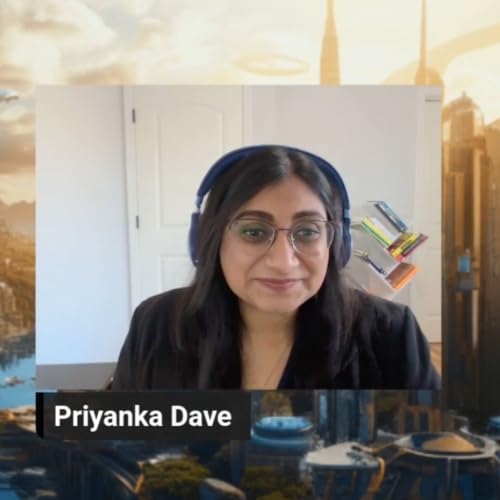
    PODCAST EPISODE | An Analog Brain In A Digital Age With Marco Ciappelli Every organization has a policy on AI. Most of them are unwritten, unspoken, and enforced by silence. Priyanka Dave — behavioral scientist, dual PhD, and the person responsible for teaching an entire university system how to work with these tools — explains what actually happens inside a company that refuses to say the word out loud. 📺 Watch | 🎙️ Listen | marcociappelli.com This conversation sat in my queue for months. I recorded it back when the show still went by another name, filed it under soon, and then buried it under travel, deadlines, and the small avalanche of everything else. So: my apologies to Priyanka Dave, who deserved better timing. What I did before publishing was listen to the whole thing again, half expecting it to have gone stale — AI conversations have the shelf life of fresh milk — and it hadn't. Not one line. That is either a compliment to her or an indictment of the rest of us. Possibly both. Here is what has held up. Priyanka Dave is a behavioral scientist with two doctorates and the unglamorous job of teaching a large public institution how to actually use these tools. Her diagnosis is not about the technology. It is about what happens when nobody in charge will say anything about it. An organization that stays quiet on AI does not prevent its people from using AI. It only stops hearing about it. Employees keep working the way they were already working — with a chatbot open in the next tab — and they simply stop mentioning it. The tool doesn't go away. The conversation does. I cover cybersecurity for a living, so I recognized this immediately. It's shadow IT with a better vocabulary. And shadow IT was never a technology failure — it was a communication failure that grew teeth. The same thing is happening now, except the data walking out the door isn't on a USB stick. It's being pasted into a text box by someone who was never told where the line is, because nobody in the building was willing to draw one. The schools got there first, and got it wrong first. Ban it, some of them announced, and the students used it anyway — badly, secretly, without a shred of judgment about when the machine is confidently wrong. Prohibition didn't produce abstinence. It produced amateurs. It always does. So Priyanka's answer is education, and here I pushed, because education has a recursion problem. If the leader is supposed to model good AI use, who taught the leader? I asked her: who educates the educator? Her answer was refreshingly unromantic. Nobody, mostly. Budgets get cut, leadership development is the first line item to go, and the executives left standing are quietly teaching themselves at night so they don't look foolish in the morning. The people expected to be the role models are improvising just like everyone else — they're only better dressed while doing it. And this is where the real cost lands. She cited the research: people leave organizations that offer them nowhere to grow. Nobody wants to miss the train. If your company won't teach you the thing that everyone agrees is coming, you will go somewhere that will — and you will take your best years with you. The company that avoided the awkward conversation about AI doesn't just end up with a hidden problem. It ends up with a smaller team. Her three tips for leaders are almost embarrassingly simple, which is how you know they're good. Ask your people what excites them about AI. Then ask what scares them. Then use the thing yourself, out loud, where everyone can see you double-check its work. Which brings me to the word I've been chewing on since we hung up: sensemaking. Priyanka listed it among the capabilities leaders need. I called it common sense, and she let me get away with it. It means not pressing the easy button. It means remembering that the thing on the other side of the screen has no context, no stake, and no idea what it is saying — even when it sounds like it does. It is not your friend. It is not your enemy. It is something else, and we haven't named it yet. So the fear was never really about the machine, was it? It was about being the last person in the room who wasn't told how to use it. Priyanka's work and writing are linked below. Subscribe to the newsletter at marcociappelli.com. Let's keep thinking. — Marco Co-Founder ITSPmagazine & Studio C60 | Creative Director | Branding & Marketing Advisor | Personal Branding Coach | Journalist | Writer | Podcast: An Analog Brain In A Digital Age ⚠️ Beware: Pigs May Fly | 🌎 LAX🛸FLR 🌍 About Marco Marco Ciappelli is Co-Founder & CMO of ITSPmagazine, Co-Founder & Creative Director of Studio C60, Branding & Marketing Advisor, Personal Branding Coach, Journalist, Writer, and Host of An Analog Brain In A Digital Age podcast. Born in Florence, Italy, and based in Los Angeles, he explores the intersection of technology, society, storytelling, and creativity — with an ...
    Show More Show Less
    31 mins
  • We Made Everything Faster. We Never Defined Better. | Lens Four by Sean Martin | Read by TAPE9
    Jul 1 2026
    ⬥EPISODE NOTES⬥ Almost every booth at Infosecurity Europe 2026 had settled on the same four words. Outcomes. Resilience. Sovereignty. Human in the loop. The messaging had grown up, more tempered than RSAC, more honest in its European register. The tell was quieter — almost none of it could connect those words to a definition of success a buyer could actually verify. Strip away the polish and the show floor was a working argument about what the cybersecurity market is for, at the exact moment the clock that governs it collapsed to seconds. The go-to-market caught up to the language. The capability did not. This is the prove-it problem, and it is worth pulling apart clearly. In this edition of Lens Four: 🔹 Why the quiet vocabulary convergence mattered more than any single product launch — outcomes, resilience, sovereignty, and human in the loop became the words everyone said, and almost none could tie them to a definition of success a buyer could verify 🔹 The number that should reorganize every SOC — the jump from initial access to the next stage collapsing from 8 hours to 22 seconds, with ransomware finishing in under an hour, most often on a Wednesday night 🔹 How Qualys reframed measurement itself — a client environment of 62 million risk findings cut to under 1% that could actually be executed, because the dashboard was never the deliverable, remediation was 🔹 Why Corelight put the same test on the detection itself — a black box tells you little, so keep the data behind every alert in the open and let an analyst prove what it actually is, the way one proof of value surfaced unencrypted sensitive traffic in 30 minutes 🔹 How Sumo Logic showed the repeatable version — prove a fix once, then let an agent apply that proven fix across 599 identical machines under human oversight, and its move into the AWS European Sovereign Cloud put something concrete under the week's sovereignty talk 🔹 What the criminal economy revealed as the honest mirror — an underground market for AI attack tools that went from 38 posts to over 1,400 in two months, tiered and redundant, an AI call center for hire that sounds like SaaS 🔹 Why the board's only real question, are we okay, now lands on the CISO as personal liability, just as AI moves from experimentation to deployment inside the organization 🔹 How consolidation and absorption are sorting the floor — 40-plus tools in silos, "make us relevant" becoming an executive hire, and the 12-to-18-month reckoning where AI absorbs functions that fill today's expo hall 🔹 The tell underneath all of it — when every booth converges on the same three or four words, the words stop doing the one job language has at a trade show: helping a buyer tell two things apart Fourth Lens: The vocabulary moved faster than the products underneath it. The industry repositioned around outcomes without ever defining the outcome, and the bill comes due over the next 12 to 18 months, not because AI arrives, but because AI removes the last place to hide the question. Naming the outcome was the easy part. Proving it repeats, across environments and teams and budgets that share nothing but the problem, is the part the vocabulary skipped. When the story can no longer be rounded up, are we okay, and can you prove it twice? 🥁 🎶 A very big THANK YOU to our Infosecurity Europe 2026 Full Coverage Sponsors: Corelight · Qualys · Sumo Logic 👏 👏 👏 ▶ Full article and references ▶ Full Infosecurity Europe 2026 coverage ▶ Subscribe to Lens Four ▶ Redefining CyberSecurity Podcast ▶ Music Evolves Podcast ▶ ITSPmagazine ▶ Studio C60 Sean Martin is a cybersecurity market analyst, content strategist, and go-to-market advisor with more than 30 years of experience across engineering, product development, marketing, and media. He is co-founder of ITSPmagazine and Studio C60, host of the Redefining CyberSecurity Podcast and Music Evolves Podcast, and co-host of On Location and Random and Unscripted. Learn more at seanmartin.com. Keywords: Infosecurity Europe 2026, cybersecurity go-to-market, security marketing, vendor positioning, machine-speed attacks, agentic AI, ransomware economics, post-quantum cryptography, boardroom liability, digital sovereignty, security tool consolidation, network detection and response, mean time to resolve, threat intelligence, resilience, Sean Martin, Lens Four Hosted by Simplecast, an AdsWizz company. See pcm.adswizz.com for information about our collection and use of personal data for advertising.
    Show More Show Less
    16 mins
adbl_web_anon_alc_button_suppression_t1
No reviews yet