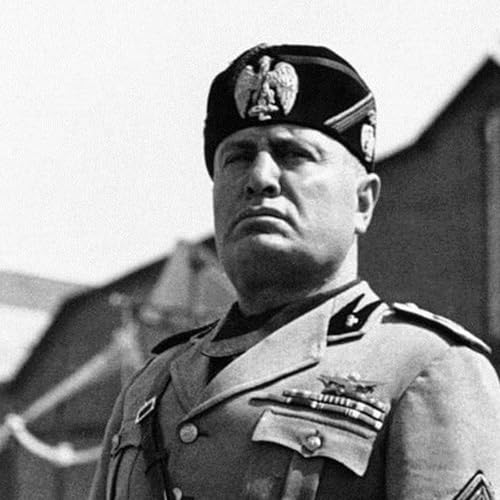
Fascism. cover art

Fascism.

Fascism.

By: Popular Culture and Religion.
Listen for free

About this listen

Fascism is a far-right, authoritarian, and ultranationalist political ideology and movement that rose to prominence in early-20th-century Europe. Fascism is characterized by support for a dictatorial leader, centralized autocracy, militarism, forcible suppression of opposition, belief in a natural social hierarchy, subordination of individual interests for the perceived interest of the nation or race, and strong regimentation of society and the economy. Opposed to communism, democracy, liberalism, pluralism, and socialism, fascism is at the far-right of the traditional left–right spectrum. What constitutes a precise definition of fascism has been a longrunning and complex debate among scholars.

The first fascist movements emerged in Italy during World War I before spreading to other European countries, most notably Germany. Fascism also had adherents outside of Europe. Fascists saw World War I as a revolution that brought massive changes to the nature of war, society, the state, and technology. The advent of total war and the mass mobilization of society erased the distinction between civilians and combatants. A military citizenship arose, in which all citizens were involved with the military in some manner. The war resulted in the rise of a powerful state capable of mobilizing millions of people to serve on the front lines, providing logistics to support them, and having unprecedented authority to intervene in the lives of citizens.

Fascism views forms of violence—including political violence, imperialist violence, and war—as means to national rejuvenation. Fascists often advocate for the establishment of a totalitarian one-party state, and for a dirigiste economy, which is a market economy in which the state plays a strong directive role through market intervention with the principal goal of achieving national economic self-sufficiency, or "autarky". Fascism emphasizes both palingenesis—national rebirth or regeneration—and modernity when it is deemed compatible with national rebirth. In promoting the nation's regeneration, fascists seek to purge it of decadence. Fascism may also centre around an ingroup-outgroup opposition and demonization of "Others", such as various ethnicities, immigrants, nations, races, political opponents of fascist parties, religious groups, and sexual and gender minorities. In the case of Nazism, this involved racial purity and a belief in a master race. Such demonization has motivated fascist regimes to commit massacres, forced sterilizations, deportations, and genocides. During World War II, the genocidal and imperialist ambitions of the fascist regimes of the Axis powers resulted in the murder of millions of people.

Since the end of World War II in 1945, fascism has been largely disgraced, and few parties have openly described themselves as fascist; the term is often used pejoratively by political opponents. The descriptions neo-fascist or post-fascist are sometimes applied to contemporary parties with ideologies similar to, or rooted in, 20th-century fascist movements.
Copyright Popular Culture and Religion.
Episodes
  • 24 - History: World War I and its aftermath (1914–1929).
    Apr 26 2026
    History: World War I and its aftermath (1914–1929). At the outbreak of World War I in August 1914, the Italian political left became severely split over its position on the war. The Italian Socialist Party (PSI) opposed the war but a number of Italian revolutionary syndicalists supported war against Germany and Austria-Hungary on the grounds that their reactionary regimes had to be defeated to ensure the success of socialism. Angelo Oliviero Olivetti formed a pro-interventionist fascio called the Revolutionary Fasces of International Action in October 1914. Benito Mussolini upon being expelled from his position as chief editor of the PSI's newspaper Avanti! for his anti-German stance, joined the interventionist cause in a separate fascio. The term "fascism" was first used in 1915 by members of Mussolini's movement, the Fasces of Revolutionary Action. The first meeting of the Fasces of Revolutionary Action was held on 24 January 1915 when Mussolini declared that it was necessary for Europe to resolve its national problems—including national borders—of Italy and elsewhere "for the ideals of justice and liberty for which oppressed peoples must acquire the right to belong to those national communities from which they descended". Attempts to hold mass meetings were ineffective and the organization was regularly harassed by government authorities and socialists. Similar political ideas arose in Germany after the outbreak of the war. German sociologist Johann Plenge spoke of the rise of a "National Socialism" in Germany within what he termed the "ideas of 1914" that were a declaration of war against the "ideas of 1789" (the French Revolution). According to Plenge, the "ideas of 1789"—such as the rights of man, democracy, individualism and liberalism—were being rejected in favor of "the ideas of 1914" that included "German values" of duty, discipline, law and order. Plenge believed that racial solidarity (Volksgemeinschaft) would replace class division and that "racial comrades" would unite to create a socialist society in the struggle of "proletarian" Germany against "capitalist" Britain. He believed that the Spirit of 1914 manifested itself in the concept of the People's League of National Socialism. This National Socialism was a form of state socialism that rejected the "idea of boundless freedom" and promoted an economy that would serve the whole of Germany under the leadership of the state. This National Socialism was opposed to capitalism because of the components that were against "the national interest" of Germany but insisted that National Socialism would strive for greater efficiency in the economy. Plenge advocated an authoritarian rational ruling elite to develop National Socialism through a hierarchical technocratic state. Impact of World War I. Fascists viewed World War I as bringing revolutionary changes in the nature of war, society, the state and technology, as the advent of total war and mass mobilization had broken down the distinction between civilian and combatant, as civilians had become a critical part in economic production for the war effort and thus arose a "military citizenship" in which all citizens were involved to the military in some manner during the war. World War I had resulted in the rise of a powerful state capable of mobilizing millions of people to serve on the front lines or provide economic production and logistics to support those on the front lines, as well as having unprecedented authority to intervene in the lives of citizens. Fascists viewed technological developments of weaponry and the state's total mobilization of its population in the war as symbolizing the beginning of a new era fusing state power with mass politics, technology and particularly the mobilizing myth that they contended had triumphed over the myth of progress and the era of liberalism. Impact of the October Revolution in Russia. The October Revolution of 1917, in which Bolshevik communists led by Vladimir Lenin seized power in Russia, greatly influenced the development of fascism. In 1917, Mussolini, as leader of the Fasces of Revolutionary Action, praised the October Revolution, but later he became unimpressed with Lenin, regarding him as merely a new version of Tsar Nicholas II. After World War I, fascists commonly campaigned on anti-Marxist agendas. Andreas Umland argues that there are similarities between fascism and Bolshevism, including that they believed in the necessity of a vanguard leadership, showed contempt for bourgeois values, and had totalitarian ambitions. He says that in practice both have commonly emphasized revolutionary action, proletarian nation theories, one-party states, and party-armies; With the antagonism between anti-interventionist Marxists and pro-interventionist fascists complete by the end of the war, the two sides became irreconcilable. The fascists presented themselves as anti-communists and as especially opposed to the Marxists. In ...
    Show More Show Less
    5 mins
  • 23 - History: Fin de siècle era and lead up to World War I (1880–1914).
    Apr 26 2026
    History: Fin de siècle era and lead up to World War I (1880–1914). The historian Zeev Sternhell has traced the ideological roots of fascism back to the 1880s and in particular to the fin de siècle theme of that time. The theme was based on a revolt against materialism, rationalism, positivism, bourgeois society, and democracy. The fin-de-siècle generation supported emotionalism, irrationalism, subjectivism, and vitalism. They regarded civilization as being in crisis, and as requiring a massive and total solution. Their intellectual school considered the individual as only one part of the larger collectivity, which should not be viewed as a numerical sum of atomized individuals. They condemned the rationalistic, liberal individualism of society and the dissolution of social links in bourgeois society. The fin-de-siècle outlook was influenced by various intellectual developments, including Darwinian biology, Gesamtkunstwerk, Arthur de Gobineau's racialism, Gustave Le Bon's psychology, and the philosophies of Friedrich Nietzsche, Fyodor Dostoyevsky, and Henri Bergson. Social Darwinism, which gained widespread acceptance, made no distinction between physical and social life, and viewed the human condition as an unceasing struggle to achieve the survival of the fittest. It challenged positivism's claim of deliberate and rational choice as the determining behaviour of humans, with social Darwinism focusing on heredity, race, and environment. Its emphasis on biogroup identity and the role of organic relations within societies fostered the legitimacy and appeal of nationalism. New theories of social and political psychology rejected the notion of human behaviour being governed by rational choice and instead claimed that emotion was more influential in political issues than reason. Nietzsche's argument that "God is dead", coinciding with his attack on the "herd mentality" of Christianity, on democracy, and on modern collectivism, his concept of the Übermensch, and his advocacy of the will to power as a primordial instinct, were major influences upon many of the fin-de-siècle generation. Bergson's claim of the existence of an élan vital, or vital instinct, centred upon free choice and rejected the processes of materialism and determinism; this challenged Marxism. French nationalist and reactionary monarchist Charles Maurras influenced fascism. Maurras promoted what he called integral nationalism, which called for the organic unity of a nation, and insisted that a powerful monarch was an ideal leader of a nation. Maurras distrusted what he considered the democratic mystification of the popular will that created an impersonal collective subject. He claimed that a powerful monarch was a personified sovereign who could exercise authority to unite a nation's people. Fascists idealized Maurras' integral nationalism, but modified into a modernized revolutionary form - devoid of Maurras' monarchism. French revolutionary syndicalist Georges Sorel (1847-1922) promoted the legitimacy of political violence in his work Reflections on Violence (1908) and in other works in which he advocated radical syndicalist action to achieve a revolution to overthrow capitalism and the bourgeoisie through a general strike. In Reflections on Violence, Sorel emphasized need for a revolutionary political religion. In his book The Illusions of Progress (1908), Sorel denounced democracy as reactionary, stating that "nothing is more aristocratic than democracy". By 1909, after the failure of a syndicalist general strike in France, Sorel and his supporters left the radical left and went to the radical right, where they sought to merge militant Catholicism and French patriotism with their views—advocating anti-republican Christian French patriots as ideal revolutionaries. Initially, Sorel had officially been a revisionist of Marxism, but by 1910 he had announced his abandonment of socialist literature. In 1914, using an aphorism of Benedetto Croce, he claimed that "socialism is dead" because of the "decomposition of Marxism". Sorel began to support reactionary Maurrassian nationalism beginning in 1909, and this influenced his works. Maurras held interest in merging his nationalist ideals with Sorelian syndicalism, known as Sorelianism, as a means to confront democracy. Maurras stated, "A socialism liberated from the democratic and cosmopolitan element fits nationalism well as a well made glove fits a beautiful hand." The fusion of Maurrassian nationalism and Sorelian syndicalism influenced radical Italian nationalist Enrico Corradini (1865-1931). Corradini spoke of the need for a nationalist-syndicalist movement, led by elitist aristocrats and anti-democrats who shared a revolutionary syndicalist commitment to direct action and a willingness to fight. Corradini spoke of Italy as being a "proletarian nation" that needed to pursue imperialism in order to challenge the "plutocratic" French and British. Corradini's views ...
    Show More Show Less
    7 mins
  • 22 - History: Background and 19th-century roots.
    Apr 26 2026
    History: Background and 19th-century roots.
    Early influences that shaped the ideology of fascism have been dated back to ancient Greece. Mussolini had a strong attachment to the works of the Greek philosopher Plato. In October 1943, Mussolini was reported to have kept Plato's work Republic on his desk at home, and he claimed to consult it from time to time before beginning his work each day. The political culture of ancient Greece and specifically the ancient Greek city state of Sparta under Lycurgus, with its emphasis on militarism and racial purity, were admired by the Nazis. Hitler emphasized that Germany should adhere to Hellenic values and culture – particularly that of ancient Sparta.
    Plato supported many similar political positions to fascism. In his work Republic (c. 380 BC), he emphasized the need for a philosopher king in an ideal state. He believed the ideal state would be ruled by an elite class of rulers known as "Guardians" and rejected the idea of social equality. He believed in an authoritarian state. He held Athenian democracy in contempt by saying: "The laws of democracy remain a dead letter, its freedom is anarchy, its equality the equality of unequals". Like fascism, he emphasized that individuals must adhere to laws and perform duties while declining to grant individuals rights to limit or reject state interference in their lives. He claimed that an ideal state would have education that was designed to promote able rulers and warriors. However, there are also significant differences between Plato's ideals and fascism. Unlike fascism, he never promoted expansionism and he was opposed to offensive war.
    Georges Valois, founder of the first non-Italian fascist party Faisceau, claimed the roots of fascism stemmed from the late 18th century Jacobin movement, seeing in its totalitarian nature a foreshadowing of the fascist state. Historian George Mosse similarly analyzed fascism as an inheritor of the mass ideology and civil religion of the French Revolution, as well as a result of the brutalization of societies in 1914–1918.
    Historians such as Irene Collins and Howard C. Payne see Napoleon III, who ran a 'police state' and suppressed the media, as a forerunner of fascism. According to David Thomson, the Italian Risorgimento of 1871 led to the 'nemesis of fascism'. William L Shirer sees a continuity from the views of Fichte and Hegel, through Bismarck, to Hitler; Robert Gerwarth speaks of a 'direct line' from Bismarck to Hitler. Julian Dierkes sees fascism as a 'particularly violent form of imperialism'.
    Marcus Garvey, founder and leader of the Universal Negro Improvement Association, had described the organisation as "the first fascists". In 1938, C. L. R. James wrote "all the things that Hitler was to do so well later, Marcus Garvey was doing in 1920 and 1921".


    Wikipedia: Text is available under the Creative Commons Attribution-ShareAlike 4.0 License.

    This episode includes AI-generated content.
    Show More Show Less
    3 mins
No reviews yet