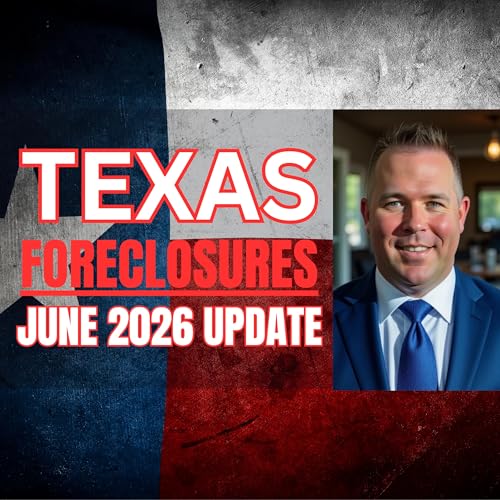
• Investing in Distressed Assets: The Q1 2026 REO and Texas Foreclosure Auction Report
    Apr 24 2026
    Navigating the New Normal in Distressed Real Estate

    Welcome back to another essential update for real estate investors, note buyers, and market watchers! We are officially in Q2 of 2026, and the landscape of distressed property is shifting rapidly. In this episode, we dive deep into the latest data from the Texas foreclosure auctions and broader national trends. Is the market entering a crisis, or are we simply returning to pre-pandemic normalization? Whether you are looking for residential opportunities in Harris County or commercial assets in North Texas, this episode provides the data-backed roadmap you need to stay ahead of the curve.


    National Trends & Q1 Market Data

    We kick things off by breaking down the latest quarterly report from Auction.com, featuring insights from industry expert Darren Blomquist. Across the USA, we are seeing a significant return to 2020 levels of market stress.

    • National Volume Spike: Foreclosure auction volume increased 33% in 2026, reaching a six-year high.
    • Widespread Distress: 44 states and the District of Columbia reported annual increases in foreclosure volume.
    • Normalization vs. Crisis: While volume is up, the data suggests a steady "normalization" to pre-pandemic levels rather than a sudden market crash.
    • Equity Erosion: Average equity for scheduled foreclosures has declined to 26.9%—a 13% drop year-over-year—driven by cooling property values.
    • The REO Shift: Banks are increasingly taking properties back at auction and listing them as REOs on digital platforms at "market-attuned" pricing.


    The Texas Lone Star Update: May 2026

    As one of the leading foreclosure states in the country, Texas is seeing a fascinating month-over-month shift. We break down the residential and commercial filings for May:


    • The Monthly Drop: Despite an annual upward trend, May saw 3,774 filings—a 20% decrease from April.
    • Commercial Snapshot: There are 456 commercial filings across Texas this month, with North Texas (DFW area) leading the charge at 144 filings.


    • County Breakdown:
    • Harris County: Remains a powerhouse with 698 residential filings.
    • Bexar County: Holding steady with 397 filings.
    • Dallas & Tarrant: Seeing slight month-over-month declines but still high-volume markets.
    • The "Zero" List: Notably, Fort Bend and Montgomery counties showed zero scheduled foreclosures in the reported data for this specific period.


    Strategies for Investors

    We also discuss how to capitalize on these trends, including a recap of our session with Texas legend Arnie Abramson on making money at tax sales. Learn why buyers are currently paying roughly 67 cents on the dollar for auction assets and how "bid-ask spreads" are narrowing as sellers adjust to sluggish conditions.


    Conclusion: Take Action in the Distressed Market

    The numbers don’t lie—the foreclosure supply is rebuilding, and the opportunities for prepared investors are growing. Don't wait for the competition to catch up. Use the resources mentioned in today's show, like Roddy’s List and Foreclosure.com, to do your due diligence and start bidding with confidence. If you found this update helpful, subscribe to the Note Closers Show Podcast and join us at the next auction. Until next time, go out there, take action, and we’ll see you at the top!


    Watch the Original VIDEO HERE!


    Got Questions? Book a Call With Scott HERE!


    Connect with Scott on LinkedIn here!


    Use Scott's AI Clone HERE!

    Show More Show Less
    26 mins
  • How to Master Texas Tax Sales & Foreclosures with Legend Arnie Abramson
    Apr 22 2026

    Are you looking to break into the Texas real estate market but tired of the heavy competition in the "Triangle" (Dallas, Houston, Austin)? In this episode, we sit down with the "Texas Tax Lien Legend" himself, Arnie Abramson. With over 30 years of experience, Arnie is the former president of the Texas REIA and an acknowledged expert in the unique world of Texas foreclosure auctions.


    We dive deep into why Texas is a Tax Deed State, not a tax lien state, and why that distinction is a massive advantage for investors. Arnie explains the mechanics of "First Tuesday" auctions, the 25% redemption penalty that works in the investor's favor, and how to find hidden gems in smaller, growing counties like Hunt, Collin, and Hays.

    If you are a new or seasoned real estate investor, this episode is a masterclass in navigating the complexities of trustee sales and tax foreclosures in the Lone Star State.

    What You’ll Learn in This Episode:
    • Tax Deeds vs. Tax Liens: Why buying the property outright is better than just buying the debt.
    • The "First Tuesday" Rule: How Texas auctions work and why timing is everything.
    • Cashier's Check Strategies: Navigating the payment requirements for different types of sales.
    • The 25% Redemption Rule: How investors earn massive returns even if a property is redeemed.
    • The Power of Smaller Markets: Why Arnie avoids the Big 5 cities and where the real profit is hiding.
    • Helping Homeowners: How Arnie uses owner-financing and "equity deals" to create win-win situations for families in distress.
    • Join the Team: Arnie is looking for partners to help with due diligence, property previews, and bidding across Texas.


    That’s a wrap on this masterclass with the man, the myth, and the legend, Arnie Abraham! If there is one thing you should take away from today, it’s that Texas real estate waits for no one—especially on the First Tuesday of the month.


    Whether you’re ready to dive into the tax deed game yourself or you want to partner up with a veteran who has seen it all, now is the time to act. Don't let these off-market opportunities pass you by while you're stuck fighting for scraps in the big cities. Grab your phone, save Arnie’s number, and start building that Texas-sized portfolio you’ve always dreamed of.


    Remember: in Texas, we do everything fast—fast highways, fast foreclosures, and fast paths to wealth if you know the right people. Thanks for tuning in, and we'll see you at the next auction!"


    Connect with Arnie Abraham:

    Arnie is looking for dedicated individuals to help expand his research and bidding operations into more Texas counties. If you want to learn the ropes and earn while you learn:

    • Phone: (214) 869-7188 (Call or Text between 7:30 AM and 9:30 PM CST)
    • Email: You can email Arnie directly at arnie@txtaxsales.com!


    Watch the Original VIDEO HERE!


    Got Questions? Book a Call With Scott HERE!


    Connect with Scott on LinkedIn here!


    Use Scott's AI Clone HERE!

    Show More Show Less
    42 mins
  • The Truth About Flipping Houses: Real Strategies vs. HGTV Myths with Al Blocker
    Apr 22 2026

    What do you do when a decade-long career at a tech giant like Microsoft comes to an abrupt end? For Al Blocker, a corporate layoff wasn't a dead end—it was the ultimate green light to turn a long-time side hustle into a real estate revolution. Join host Scott Carson as he sits down with the host of the Rip and Flip podcast, Al Blocker, to discuss his journey from "accidental" landlord to a dominant force in the D.C., Maryland, and Virginia real estate markets. This isn't the "polished for TV" version of house flipping; it’s a masterclass in the grit, math, and mindset required to succeed when the corporate safety net is pulled away.


    In This Episode, We Cover:

    • The Microsoft Pivot: How Al transitioned from 11 years at Microsoft and a sudden startup layoff to full-time real estate investing.
    • TV vs. Reality: Why HGTV "one-hour flips" are a facade and what the real timeline and struggle of a renovation look like.
    • The 10% Golden Rule: Why Al insists every investor must earmark a 10% contingency fund to survive unforeseen project "hits".
    • The "Ugly House" Strategy: Al’s specific buy-box: finding the ugliest house on the best street and using "bones and vision" to add massive value.
    • Navigating Permitting Hell: How to handle the red tape that can delay a project by months and eat your profits.
    • Scaling with 1031 Mindsets: How Al used proceeds from early flips to fuel "scores and scores" of subsequent deals, moving from 10% to 20% profit margins.
    • Market Resilience: Staying focused and "plowing ahead" through COVID-19 supply chain issues and rising interest rates.


    Whether you are a corporate professional looking for an "ace in the hole" side hustle or a seasoned investor trying to refine your profit margins, Al Blocker’s journey is a testament to the power of persistence. Al proves that while the market may change and layoffs may happen, a solid system and "thick skin" can turn any setback into a major comeback. Don’t just watch the shows—learn the business of the rip and flip.


    Connect with Al Blocker HERE!


    Watch the Original Video of this Episode HERE!

    Got Questions? Book a Call With Scott HERE!


    Connect with Scott on LinkedIn here!


    Use Scott's AI Clone HERE!
    Show More Show Less
    37 mins
  • A Step-by-Step Follow-Up System for Private Money in Fort Worth
    Apr 17 2026
    The Art of the Follow-Up: Turning "No" into Private Capital

    Are you tired of finding great real estate deals only to have them stall because you lack the funding? Many investors believe that "raising capital" is a one-time pitch, but the reality is much more persistent. In the world of private money, the fortune is truly in the follow-up. While most people give up after the first attempt, the elite investors—the ones closing deals month after month—know that a "no" today is often just a "not yet" for tomorrow.

    In this episode, we dive deep into the systematic approach to raising private capital, treating your marketing like a professional athlete treats their swing. Whether you are a seasoned note investor or just starting out, mastering these nine steps of follow-up will ensure you never run out of fuel for your deals again.


    Key Takeaways from This Episode

    Raising capital is a skill developed through repetition and persistence. Here is the breakdown of the follow-up system discussed:


    • The Power of 80%: Approximately 80% of sales are made between the 5th and 12th contact, yet nearly half of all professionals never follow up a second time.


    • The Baseball Analogy: Raising capital is like hitting in baseball; even the best fail 70% of the time. You must keep taking "swings" (marketing attempts) to eventually hit your singles, doubles, and home runs.


    • Mining the Right List: Successful fundraising starts with a quality list, such as Self-Directed IRA (SDIRA) owners found through county appraisal districts.


    • The Multi-Channel Approach: Effective follow-up isn't just letters; it involves a mix of direct mail, social media sleuthing, email marketing, and SMS text blasts.


    • The "Hello Letter": Your first touch should be a professional, printed letter (not a "yellow letter") that includes a QR code to your pitch deck.


    • Social Sleuthing: Use VAs to find LinkedIn and Facebook profiles of your leads. Sending a personalized DM is a low-cost, high-impact way to move a cold lead into your CRM.


    • Case Studies as Fuel: Don’t just "check in." Share case studies of deals you are evaluating or have closed to show prospects that you are an active, credible investor.


    • The Power of SMS: Text messages have an 85% open rate within the first five minutes, making them far more effective than the 17-20% open rate typical of emails.


    • The Essential Toolkit: To go pro, you need four core assets: a professional website, a 10-minute pitch deck video, a CRM with open-rate tracking, and a consistent schedule.


    Stop Waiting for the "Whale"

    Many investors spend their time chasing one giant "whale" investor, but this system is built on singles and doubles. By consistently touching your market once a week or once a month, you build an "avalanche" of capital that snowballs over time. Remember, the best time to raise capital is before you actually need it. Start your marketing today, stay coachable, and watch your real estate business transform.


    Ready to scale? Don't let your leads drift away "like smoke in the wind". Implement these follow-up steps and start hitting your funding goals!


    Watch the Original VIDEO HERE!


    Got Questions? Book a Call With Scott HERE!


    Connect with Scott on LinkedIn here!


    Use Scott's AI Clone HERE!

    Show More Show Less
    35 mins
  • Real Estate Marketing Hustle: Why You’re Not Closing Deals in 2026
    Apr 15 2026
    Stop Being a Crybaby: Are You Working the Deal or Waiting for a Miracle?

    The year is 2026, and the real estate market isn't what it was last year, let alone five years ago. If you find yourself struggling to close deals or complaining about a lack of funding, it’s time for a serious reality check. In this episode, Scott Carson dives deep into the "mental side" of the business, stripping away the excuses that keep investors paralyzed. Whether you’re a seasoned pro or a new realtor looking for distressed opportunities, the message is clear: Your success is directly tied to your marketing volume.


    Scott takes us back to his darkest days in 2009—living in a $400-a-month room, eating canned beans, and facing foreclosure himself. He didn’t wait for a bailout or a "funding Jesus" to descend from the clouds. He hustled, expanded his market, and turned a desperate situation into a $35,000 wholesale win. If you’re tired of being "sick and tired," this is the wake-up call you need to get off the sidelines and back into the game.


    Key Takeaways for the 2026 Market Hustle
    • Expand Your Horizons: Stop looking for deals in one tiny backyard. If your local area is dry, use the internet to market across multiple states where the inventory is actually moving.


    • Fire Your "Old" Money Partners: If your previous investors refuse to fund distressed assets, sub-two deals, or non-performing notes, they aren't your partners anymore. You must go out and create new funding sources through aggressive networking.


    • The 80% Rule of Sales: Most success happens after the fifth contact. Sending one email blast and giving up isn't marketing; it's laziness. You have to "carpet bomb" your message across Facebook, LinkedIn, and email databases.


    • Leverage Case Studies: Even if you’ve only done a few deals, use them as proof of concept. Share your wins and your "near-foreclosures" as case studies to attract new investors.


    • Show Up Where the Money Is: Stop avoiding the "scary" places. Go to local foreclosure auctions and REIA club meetings. The people bidding there have the cash you need; you are just one connection away from your next deal.


    • Stop the Political Blame Game: Your bank account doesn't care who is in the White House. If you spend more time complaining about politics than you do skip-tracing leads, you are the reason you aren't succeeding.


    • Dumbify the Deal: When presenting to new partners who don’t understand the note business, break it down on a whiteboard. Show the numbers, the BPO, and the potential yield in simple terms.

    Conclusion: No Free Lunches

    At the end of the day, you are where you are because of the decisions you've made. There is no "free lunch" in real estate. You have to be willing to make sacrifices—maybe that means stepping back from coaching soccer for a season so you can spend those two hours marketing your business.


    Remember Scott's $35K win: he didn't have the money to buy the note, but he had the "hustle jacket" on. He got the contract, marketed it everywhere, and closed the gap. Stop feeding yourself the "bullshit" that you aren't smart enough or good enough. Get beyond your comfort zone, take massive action, and remember: Chimichangas are for winners.


    Ready to get to work? Reach out to Scott, and let’s see if you’re ready to handle the tough questions.


    Watch the Original VIDEO HERE!


    Got Questions? Book a Call With Scott HERE!


    Connect with Scott on LinkedIn here!


    Use Scott's AI Clone HERE!

    Show More Show Less
    27 mins
  • Owner Finance Secrets: How to Structure Notes for a Big Payday
    Apr 13 2026
    Mastering the Note: How to Structure Owner-Financed Deals for Maximum Value

    Are you tired of leaving money on the table when selling your real estate notes? Whether you are a seasoned investor or just starting to explore the world of owner financing, the way you structure your paper today dictates your payday tomorrow. In this episode, we dive deep into the mechanics of creating "sellable" paper. We aren't just talking about collecting monthly checks; we are talking about building an asset that Wall Street and private mortgage funds actually want to buy. If you’ve ever been frustrated by lowball offers or wondered why some notes sell at par while others take a 40% haircut, this guide is for you. We’re moving beyond the "we buy notes" postcards and getting into the high-level coaching you need to protect your equity and your future.


    Key Strategies for High-Value Note Creation

    To ensure your note is marketable on the secondary market and maintains its value, you must avoid the "cheap" mistakes that kill deals. Here is the blueprint for a properly structured note:


    • Mandatory Use of an RMLO: Always hire a Registered Mortgage Loan Originator to handle your documentation. They ensure your loan is Dodd-Frank compliant and provide the "uniform paper" look—including credit reports and 1003 applications—that institutional buyers require.


    • The Power of Third-Party Servicing: Do not self-service your loans. For a small monthly fee, a professional servicer provides an official third-party payment history, manages escrow for taxes and insurance, and handles borrower outreach within legal guidelines.


    • Optimal Down Payment & LTV: Aim for a minimum of 10% down to build immediate equity and reduce default risk. A Loan-to-Value (LTV) ratio of 90% or less is the gold standard for marketability.


    • Market-Rate Interest Benchmarks: In the current 2026 market, notes with interest rates below 8% will face significant discounts on the secondary market. To avoid a "haircut," structure your notes at or slightly above current market rates.


    • Creative "Two-Lien" Structuring: Instead of one 90% LTV loan, consider a 75% first lien and a 15% second lien. This allows you to sell the first lien close to par while keeping the second lien for pure cash flow in your portfolio or IRA.


    • Borrower Qualifications: Prioritize borrowers with a FICO score of 620 or higher and a Debt-to-Income (DTI) ratio below 50%. If a borrower cannot qualify at 8% interest with 10% down, it is often better to list the property traditionally than to create "bad paper".


    • Avoiding Over-Valuation: Never sell a property significantly above its fair market value just to create a larger note. Note buyers will base their offers on the actual asset value, not your inflated sales price.


    Don't let a "bag of crap" of advice from the internet ruin your exit strategy. Owner financing is one of the most powerful tools in real estate, but it requires precision and professional oversight to be truly profitable. By utilizing RMLOs, professional servicing, and smart multi-lien structures, you aren't just a landlord—you are the bank. Remember, life happens; you may not plan to sell your note today, but you want to ensure that if you ever need to, the door to that "long hallway" of funding is wide open. Take action, structure your deals properly, and let's keep making smart moves in the note space. See you at the top!


    Watch the Original VIDEO HERE!


    Got Questions? Book a Call With Scott HERE!


    Connect with Scott on LinkedIn here!


    Use Scott's AI Clone HERE!

    Show More Show Less
    37 mins
  • How to Make Six-Figures Per Year Without Toilets, Tenants, and Trashouts!
    Apr 10 2026
    The 2026 Wealth Blueprint: How to Replace Your Salary by Becoming the Bank

    Are you tired of the "Tenants, Toilets, and Trash" that come with traditional landlording? Most investors think the only way to build a six-figure real estate business is through physical property management, but the real wealth is hidden in the debt. In this episode, we break down the updated 2026 roadmap for transitioning from a property manager to an asset manager. We’re diving deep into the exact math of how to acquire distressed mortgage notes at a massive discount, leverage private capital, and create a "rinse and repeat" cash flow engine that doesn't require a single middle-of-the-night repair call.


    Key Takeaways from the 2026 Strategy


    • The Power of the Discount: Learn why targeting non-performing notes at 50% of fair market value allows you to build immediate equity without picking up a hammer.


    • Engineering Your Exit from the 9-to-5: To replace a $60,000 annual salary, you only need approximately 15 notes netting $333 per month each—a far more scalable path than managing dozens of low-margin rental units.


    • Scaling with Private Capital (OPM): Discover how to offer private investors an 8% return—far better than they’ll find in a standard savings account—to fund your deals while you keep the majority of the monthly spread.


    • Getting Paid to Negotiate: Understand the "Skin in the Game" strategy, where you collect upfront payments from borrowers to help them stay in their homes, potentially generating $30,000 in immediate income before the first monthly check even arrives.


    • The Triple-Threat Payday: This model doesn't just offer monthly cash flow; it combines upfront fees, monthly interest, and a massive back-end profit when you sell "seasoned" reperforming notes to larger institutional funds.


    Conclusion

    True financial freedom in 2026 isn't about working harder; it’s about having a plan and refusing to be a "secret agent" in your own market. By shifting your focus from owning the "bricks and mortar" to owning the debt, you can build a multi-million dollar portfolio with fewer headaches and higher margins. Stop chasing "certificates of disappointment" and start using the bank's own playbook to secure your future.


    Watch the Original Video of this Episode HERE!

    Got Questions? Book a Call With Scott HERE!


    Connect with Scott on LinkedIn here!


    Use Scott's AI Clone HERE!

    Show More Show Less
    31 mins
  • How to Use the Tarrant County Foreclosure Auction to Raise Capital and Find Deals
    Apr 8 2026
    The Courthouse Goldmine: Leveraging Local Auctions Beyond the Bid

    Are you looking for more deals, more buyers, or more private capital to fund your real estate empire? Most investors look at the foreclosure auction and see only one thing: a place to buy a house. But what if the most valuable asset at the courthouse isn't the property on the block, but the people standing around it? In this episode, we dive into the "Super Tuesday" phenomenon in Texas and show you how to turn your local foreclosure auction into a high-powered networking and lead-generation machine.

    If you’ve been struggling to find active cash buyers or looking for private money partners, it’s time to get out of the office and onto the courthouse steps. We’re breaking down the exact strategy for "form-tackling" the auction—not to outbid the competition, but to build a database of the most active players in your market. Whether you’re in Travis, Bexar, or Dallas County, this "boots-on-the-ground" approach is the fastest way to accelerate your real estate career in 2026.


    What You’ll Learn in This Episode:
    • The Power of "Super Tuesday" in Texas: We discuss the unique structure of Texas foreclosure auctions, which happen on the first Tuesday of every month, and how to use the public bulletin boards at the county recorder’s office to prep your strategy the day before.
    • Networking for Capital and Buyers: Learn why the courthouse steps are the best place to find "verified" cash buyers. If someone is there with a cashier's check ready to bid, they are the exact person you want on your buyer's list for your next wholesale or note deal.
    • The "Form-Tackle" Strategy: I share my tactical approach to networking at the auction. By introducing yourself to the regulars and the "vulture" investors, you can find out exactly what they are looking for and how you can bring them deals that meet their specific criteria.
    • Leveraging Other People’s Research: Why you don't necessarily need to buy the expensive foreclosure lists yourself. We talk about how to connect with the people who have already done the legwork, potentially saving you hundreds of dollars in marketing costs while gaining high-quality data.
    • Building Real-World Credibility: We discuss the importance of being physically present. Taking a photo or a quick video at the auction isn't just for social media; it’s a way to show your potential private money partners that you are an active, "in-the-field" investor who knows the local market.

    Conclusion The foreclosure auction is a microcosm of the real estate market, and if you aren't there, you're missing out on more than just a house—you're missing out on the relationships that build long-term wealth. Real estate is a contact sport, and success goes to those who are willing to show up, shake hands, and take action. So, grab your notebook, head down to the courthouse this coming Tuesday, and start making those connections that will define your second quarter.


    Ready to take your action to the next level? If you’re at the auction, snap a photo and text it to me at (512) 585-3810—I’ve got a special surprise for those who are out there doing the work. For more advanced strategies on note investing and deal flow, visit https://talkwithscottcarson.com or weclosenotes.com.


    Don’t forget to subscribe and leave a five-star review to stay ahead of the Texas real estate markets!


    Watch the Original Video of this Episode HERE!


    Got Questions? Book a Call With Scott HERE!


    Connect with Scott on LinkedIn here!


    Use Scott's AI Clone HERE!

    Show More Show Less
    18 mins