• Significance of Labour Day in the age of AI - Debate!
    May 1 2026

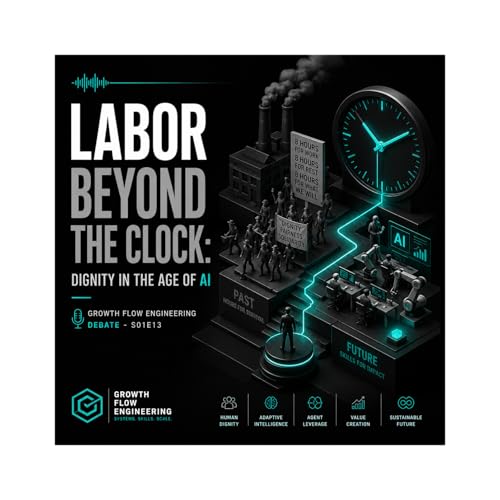
    The 19th century fought for the 8-hour day. The 21st century is fighting for the sovereignty of the human mind.

    Labor Day was born out of a brutal fact: industrial capitalism once ran on 16-hour shifts and child labor. The original movement wasn't just a lifestyle choice—it was a fundamental argument about what a human life is for.

    Today, the battlefield has shifted from the factory floor to the algorithm.

    We are moving into an era where the classic unit of labor—hours supplied by a human body—is being challenged by a new unit: human judgment amplified by machine execution. AI is no longer just replacing hand motions; it is invading the white-collar sentence and reshaping tasks within almost every occupation.

    As we look beyond the clock, the core conflict is no longer just labor versus capital. It is:

    • Operator vs. Algorithm: Who controls the workflow?
    • Architect vs. Executor: Who designs the systems we all live in?
    • Agency vs. Surveillance: Are we "agent bosses" or just data points for management telemetry?

    The future of work isn't just about "using AI." It’s about building a labor identity centered on diagnostic skill, workflow design, and human dignity.

    We’ve put together a deck exploring how we move from "time theft" to "task leverage" and why the struggle for dignity in the age of AI is the most important conversation of our time.

    Read more: https://www.linkedin.com/posts/mosessampaul_labour-day-in-the-age-of-ai-ugcPost-7455923577968820224-onuA?utm_source=share&utm_medium=member_desktop&rcm=ACoAAAH71PEB-YyDe8Qo-X795jUEtrdnz6y-29c

    #FutureOfWork #AI #LaborDay #GrowthFlowEngineering #DigitalDignity

    Show More Show Less
    22 mins
  • 12. KPI Architecture - The Language of Enterprise AI Transformation.
    Mar 14 2026

    This podcast introduces KPI Architecture, a rigorous framework designed to transform business metrics from vague narrative opinions into mathematical truths. By drawing parallels to historical navigational disasters and the precision of a mechanical chronometer, the author argues that effective metrics must be built upon standardised formulas, verifiable data sources, and clear ownership. This system eliminates the costly ambiguity of "vanity metrics" by enforcing a formula-first constitution where every tactical measure must explicitly predict a strategic outcome. Ultimately, the source serves as a guide for leaders to replace "forecast theatre" with a version-controlled schema that ensures measurement remains accurate, live, and immune to interpretive drift.

    Book: The Language of Enterprise AI Transformation.

    Author: Moses Sam Paul

    Partner at Growth Flow Engineering

    Contact: Content@GrowthFlowEngineering.xyz

    Show More Show Less
    17 mins
  • 11. Dual-Repository Architecture - The Language of Enterprise AI Transformation.
    Mar 13 2026

    This podcast describes the Dual-Repository Architecture, a structural method for protecting an organisation's core logic from the distorting influence of external communication. Drawing on historical and philosophical parallels like the Magna Carta and Vedic traditions, the author argues that truth must be structurally separated from authority to prevent the corruption of essential definitions and metrics. This is achieved by maintaining two distinct repositories: a private "Church" containing immutable mathematical truths and a public "State" dedicated to market-facing authority and lead generation. Information flows strictly in one direction through an automated hydration pipeline, ensuring that public-facing content remains a perfect, unalterable reflection of the underlying technical specifications. Ultimately, this architecture aims to eliminate semantic drift, ensuring that every internal agent and external stakeholder operates from a single, uncompromised source of truth.

    Book: The Language of Enterprise AI Transformation.

    Author: Moses Sam Paul

    Partner at Growth Flow Engineering

    Contact: Content@GrowthFlowEngineering.xyz

    Show More Show Less
    24 mins
  • 10. The Architecture of Process Orchestration - The Language of Enterprise AI Transformation.
    Mar 12 2026

    This chapter outlines a modular framework for business growth, where Process Orchestration acts as the "interface contract" that allows individual tasks to click together like LEGO bricks. By defining work through strictly typed, executable specifications rather than vague instructions, the system ensures that every action is compatible, measurable, and directly linked to strategic goals. This architecture eliminates "zombie processes"—redundant workflows that consume resources without purpose—by requiring every activity to be mapped to an active OKR and specific KPIs. Ultimately, the source argues that composable growth allows a company to scale efficiently, as a finite library of "hydrated tasks" can be reconfigured into a vast array of revenue-generating capabilities.

    Book: The Language of Enterprise AI Transformation.

    Author: Moses Sam Paul

    Partner at Growth Flow Engineering

    Contact: Content@GrowthFlowEngineering.xyz

    Show More Show Less
    20 mins
  • 9. Spec Integrity - Task Hydration - The Language of Enterprise AI Transformation.
    Mar 11 2026

    This chapter argues that organizational efficiency relies on spec integrity, where tasks are treated as high-precision engineering blueprints rather than vague suggestions. By utilizing a concept called task hydration, leaders transform empty titles into executable infrastructure by adding specific tools, proof types, and success criteria to every assignment. This rigorous approach mirrors NASA’s engineering standards and video game logic, ensuring that work is only considered complete when its outcome is system-verifiable rather than subjective. Ultimately, the source serves as a strategic mandate to eliminate ambiguity, allowing both human workers and AI agents to operate with total clarity and disciplined execution.

    Book: The Language of Enterprise AI Transformation.

    Author: Moses Sam Paul

    Partner at Growth Flow Engineering

    Contact: Content@GrowthFlowEngineering.xyz

    Show More Show Less
    23 mins
  • 8. The Internal Value Chain - The Language of Enterprise AI Transformation.
    Mar 10 2026

    The Internal Value Chain (IVC) is presented as a computational architecture that transforms abstract business activities into a structured, 9-node directed graph of meaning. Inspired by Linnaeus’s universal naming system, this framework assigns a specific coordinate to every unit of work, ensuring that every action is traceable to the organization’s ultimate financial valuation. By connecting two distinct paths—one for cash-flow generation and another for risk mitigation—the system eliminates "Ghost Value" and ensures that strategic goals are backed by verifiable data. Ultimately, the IVC serves as a navigation system for enterprise value, moving beyond traditional hierarchy to create a rigorous, interconnected network where higher-level outcomes depend entirely on the integrity of lower-level data.

    Book: The Language of Enterprise AI Transformation.

    Author: Moses Sam Paul

    Partner at Growth Flow Engineering

    Contact: Content@GrowthFlowEngineering.xyz

    Show More Show Less
    22 mins
  • 7. The Least Common Vocabulary (LCV) - The Language of Enterprise AI Transformation.
    Mar 9 2026

    The Least Common Vocabulary (LCV) is a strategic framework designed to eliminate "Ghost Value"—the economic loss occurring when different departments fail to align during critical transitions. Rather than pursuing the impossible goal of a universal corporate language, the LCV focuses exclusively on locking the handoffs by establishing the minimum viable semantic agreement at system boundaries. By creating surgical interventions at these junctions, organizations ensure that value moves between teams, such as Marketing and Finance, without any "semantic remainder" or confusion. Valid LCV nodes must be boundary-relevant, machine-executable, bidirectionally acknowledged, and ValueLog-enforced to ensure they are functional rather than merely theoretical. Ultimately, this approach treats organizational communication like a technical standard, prioritizing economic leakage reduction over unnecessary, broad-scale linguistic alignment. Size: 1:1

    Book: The Language of Enterprise AI Transformation.

    Author: Moses Sam Paul

    Partner at Growth Flow Engineering

    Contact: Content@GrowthFlowEngineering.xyz

    Show More Show Less
    20 mins
  • 6. Truth Distillation - The Language of Enterprise AI Transformation.
    Mar 8 2026

    This text introduces Truth Distillation, a methodology for converting vague organizational strategies into binary, machine-readable syntax that eliminates human misinterpretation. By comparing modern business goals to Hammurabi’s Code and Toyota’s Production System, the author argues that true coordination requires encoding intent into explicit decision trees and rigid specifications rather than relying on "conversational fluff." This process is described as a "violent" act because it destroys plausible deniability and forces leaders to replace aspirational language with observable formulas and execution-ready specs. Ultimately, the chapter serves as a mandate for organizations to increase their Truth Distillation Ratio, ensuring that strategy is no longer a narrative placeholder but a system-executable governing document that AI and humans can follow without ambiguity.

    Book: The Language of Enterprise AI Transformation.

    Author: Moses Sam Paul

    Partner at Growth Flow Engineering

    Contact: Content@GrowthFlowEngineering.xyz

    Show More Show Less
    19 mins