• Episode 41 | Unite Before You Ignite: Lessons from Nepal's Youth-Led Democracy
    May 25 2026

    This episode brings together three Nepali changemakers, public speaker Aadarsha Bikram Singh, lawyer Tanuja Pandey, and peacebuilding researcher, Dr. Nar Bahadur Saud, to unpack the historic September 2025 Gen Z movement that toppled Nepal's government. They explain how decades of corruption, forced out-migration, and a sudden social media ban pushed young people into the streets, fueled by the viral #NepoBaby and #NepoKids hashtags borrowed from Indonesia's earlier uprising. The conversation honors the 76 lives lost on September 9, traces the remarkably swift transition to a peaceful 2026 election, and introduces a parliament now full of young faces including a 36-year-old Prime Minister. But the guests are refreshingly honest about the uncertainty ahead: creeping populism, weak institutional memory, and the temptation to dismantle without rebuilding. Their closing advice for global youth movements is unforgettable — unite before you ignite, collaborate across generations, read history, and let love walk beside the rage.

    Contact Conversations4citizenship

    • Tweet us @c4c_ed and @stellarcheong
    • Bluesky @c4cpodcast.bsky.social.
    • Email us at conversations4citizenship@gmail.com
    • Submit your work us at http://www.conversations4citizenship.com
    • You can now follow the Conversations4Citizenship on Bluesky @c4cpodcast.bsky.social

    Thanks for listening and keeping Conversations4Citizenship podcasting!

    Show More Show Less
    1 hr and 12 mins
  • Episode 40 | Beyond "I Agree": Data Sovereignty and the AI Black Box Featuring Ken Katayama
    Apr 18 2026

    Welcome back to Conversations4Citizenship as we kick off Season 5 with our brand-new theme: "The New World Order". To get things started, hosts Stella and Kamille sit down with Ken Katayama, a Digital Policy Evangelist from Japan, for an eye-opening chat about our hyper-connected lives. Throughout the episode, they unpack the hidden dangers of the AI "black box" and explore what data sovereignty truly means when tech giants silently gather our most intimate details. Furthermore, the conversation seamlessly shifts to tackle the ethical implications of mass surveillance, highlighting the stark differences in global privacy laws—from Europe's strict GDPR to the fragmented rules in the US and developing nations. Ultimately, Ken leaves us with a powerful reminder that while technology will inevitably advance, keeping humans at the center and building genuine trust are the true keys to navigating our digital future. Tune in to discover why simply clicking "I Agree" is no longer enough to protect yourself!

    Contact Conversations4citizenship

    • Tweet us @c4c_ed and @stellarcheong
    • Bluesky @c4cpodcast.bsky.social.
    • Email us at conversations4citizenship@gmail.com
    • Submit your work us at http://www.conversations4citizenship.com
    • You can now follow the Conversations4Citizenship on Bluesky @c4cpodcast.bsky.social

    Thanks for listening and keeping Conversations4Citizenship podcasting!

    Show More Show Less
    45 mins
  • Season 4 Reflections and 2025 Year in Review with Dr. Kamille Beye
    Mar 1 2026

    In this Conversations4Citizenship Season 4 reflection, co-host Dr. Kamille Beye examines the profound global and educational disruptions of 2025. She highlights how cuts to USAID and university diversity funding emphasize the fragility of educational access, alongside global challenges like ongoing conflicts, the Syrian revolution, and the disruptive rise of AI. Amidst these shifting landscapes, Dr. Beye recaps Season 4's impactful episodes, which explored South Korean youth activism, philosophical diversity, school participatory budgeting, labor rights, higher education access, and the significance of memory sites. Acknowledging the heavy toll of political upheaval, misinformation, and climate change throughout the year, Beye draws inspiration from Dr. Martin Luther King Jr., reminding listeners to balance finite disappointment with infinite hope. She concludes by urging global citizens to remain deeply engaged, advocate for justice, and carry resilience forward as they navigate the uncertain headwinds of 2026.

    Contact Conversations4citizenship

    • Tweet us @c4c_ed and @stellarcheong
    • Bluesky @c4cpodcast.bsky.social.
    • Email us at conversations4citizenship@gmail.com
    • Submit your work us at http://www.conversations4citizenship.com
    • You can now follow the Conversations4Citizenship on Bluesky @c4cpodcast.bsky.social

    Thanks for listening and keeping Conversations4Citizenship podcasting!

    Show More Show Less
    8 mins
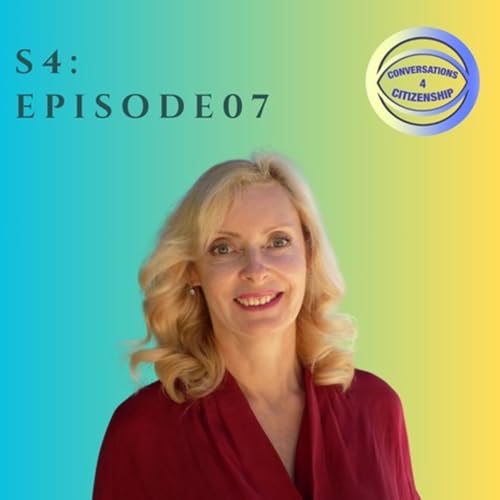
  • Episode 07 | Rethinking History with Prof. Korostelina: Identity, Reconciliation and the Power of Memory in Peacebuilding
    Feb 3 2026

    In this enlightening episode, Dr. Stella Micheong Cheong and her co-hosts welcome Dr. Karina Korostelina, Director of the Sustainable Peace Lab at George Mason University, to discuss the profound impact of collective memory on conflict and reconciliation. Korostelina argues that physical locations such as monuments and museums, are not merely static records of the past but active political tools that shape national identity and future conflict dynamics. She introduces concepts from her new book, Memory Sites and Conflict Dynamics, explaining how these sites often 'ascribe' negative traits to perceived enemies or 'enhance' a group's own narrative at the expense of others. Furthermore, the conversation challenges the traditional liberal peace model, advocating instead for a local turn that prioritizes community resilience and agonistic history—acknowledging multiple, coexisting interpretations of the same events. Ultimately, Dr. Korostelina emphasizes that education is key to disrupting monolithic narratives and fostering lasting peace.

    This episode is hosted by Dr. Stella Micheong Cheong. Please subscribe to the podcast through Apple, Spotify, Amazon Music or Audible. You may also follow @c4cpodcast.bsky.social on Bluesky. We look forward to hearing your feedback. If you would like to explore participating in our podcast and submit your blog post to the C4C, do not hesitate to reach out through the online participation form or email us at conversations4citizenship@gmail.com

    If you are curious about Memory Sites and Conflict Dynamics, check out her new book, 'Memory Sites and Conflict DynamicsCollective Memory, Identity, and Power' and visit the Sustainable Peace Lab's website linked below.

    • Korostelina, K. V. (2025). Memory Sites and Conflict Dynamics: Collective Memory, Identity, and Power. Routledge.
    • Korostelina, K. V., Gopin, M., Helsing, J. W., & Özerdem, A. (Eds.). (2024). Identity and religion in peace processes: Mechanisms, strategies and tactics. Taylor & Francis.
    • The Sustainable Peace Lab

    Contact Conversations4citizenship

    • Tweet us @c4c_ed and @stellarcheong
    • Bluesky @c4cpodcast.bsky.social.
    • Email us at conversations4citizenship@gmail.com
    • Submit your work us at http://www.conversations4citizenship.com
    • You can now follow the Conversations4Citizenship on Bluesky @c4cpodcast.bsky.social

    Thanks for listening and keeping Conversations4Citizenship podcasting!

    Show More Show Less
    51 mins
  • Episode 06 | Global Higher Education in Crisis: 3 Hosts' Perspectives from the US, UK, and Korea
    Jan 4 2026

    In this episode, Drs. Adam Peter Lang, Kamille Beye, and Stella Micheong Cheong engage in a comprehensive three-way discussion regarding the geopolitical and structural challenges facing higher education globally. Dr. Beye begins by highlighting the "tumultuous" landscape in the US, where the Trump administration’s policies against Diversity, Equity, and Inclusion (DEI) have led to the revocation of research grants and created visa uncertainties for international students. Transitioning to South Korea, Dr. Cheong explains the intense societal pressure surrounding the "SKY" universities, describing a rigid "caste system" where academic credentials determine life success while vocational paths remain deeply stigmatized. Meanwhile, Dr. Lang details the UK’s deepening financial crisis, noting that nearly 40% of universities face deficits, resulting in mergers and significant staff redundancies. Despite these struggles, the hosts conclude with optimism, viewing these crises as potential catalysts for educational reform.

    Contact Conversations4citizenship

    • Tweet us @c4c_ed and @stellarcheong
    • Bluesky @c4cpodcast.bsky.social.
    • Email us at conversations4citizenship@gmail.com
    • Submit your work us at http://www.conversations4citizenship.com
    • You can now follow the Conversations4Citizenship on Bluesky @c4cpodcast.bsky.social

    Thanks for listening and keeping Conversations4Citizenship podcasting!

    Show More Show Less
    52 mins
  • Episode 05 | Prof. Atherton's Vision on Widening Access: Fighting Inequality in Global Higher Education
    Dec 22 2025

    In this episode, Dr. Adam Peter Lang and Dr. Kamille Beye interview Professor Graeme Atherton about the pressing global challenges of inequality and access in higher education. Professor Atherton, who leads the World Access to Higher Education Network (WAHEN) and the Ruskin Institute for Social Equity, shares his personal journey from a council estate in Blackpool to Oxford University, highlighting how this experience shaped his lifelong dedication to widening participation. He discusses the growing 'ideological pushback' against the value of inclusive education by populist movements and the structural difficulties of adapting elite university systems to serve the majority. The conversation also explores the historic role of Ruskin College in educating working-class adults and the complexities of ensuring international partnerships in the Global South remain genuinely equitable. Finally, Atherton emphasizes the need for curricula to adapt to AI while ensuring marginalized voices remain central to educational policy.

    This episode is hosted by Dr. Adam Lang. Please subscribe to the podcast through Apple, Spotify, Amazon Music or Audible. You may also follow @c4cpodcast.bsky.social on Bluesky. We look forward to hearing your feedback. If you would like to explore participating in our podcast and submit your blog post to the C4C, do not hesitate to reach out through the online participation form or email us at conversations4citizenship@gmail.com

    If you are curious about the World Access to Higher Education Network (WAHEN), check out his new book, 'Making Equal' and visit the WAHEN's website linked below.

    • Atherton, G., & John, P. (Eds.). (2025). Making Equal: New Visions for Opportunity and Growth. Emerald Publishing Limited.
    • World Access to Higher Education Network (WAHEN)
    • Ruskin Institute for Social Equity (RISE)

    Contact Conversations4citizenship

    • Tweet us @c4c_ed and @stellarcheong
    • Bluesky @c4cpodcast.bsky.social.
    • Email us at conversations4citizenship@gmail.com
    • Submit your work us at http://www.conversations4citizenship.com
    • You can now follow the Conversations4Citizenship on Bluesky @c4cpodcast.bsky.social

    Thanks for listening and keeping Conversations4Citizenship podcasting!

    Show More Show Less
    45 mins
  • Episode 04 | Art as Advocacy : Literature and Human Rights Education in the Philippines
    Aug 22 2025
    Professor Rommel Rodriguez, an academic, writer, and staunch human rights advocate from the University of the Philippines, provides a profound overview of the nation's struggle for social justice. He begins by outlining the deep-seated issues of poverty, neocolonialism, and environmental problems that fuel a culture of protest. He details the nation's robust history of protest, from the 1986 People Power Revolution to contemporary movements addressing systemic issues like poverty and corruption.A significant portion of the conversation focuses on the dark legacy of the Ferdinand Marcos dictatorship and the current challenges of historical revisionism, particularly under the current government of Ferdinand Marcos Jr., the son of the former dictator, which seeks to erase the dark parts of the country's past.To counter this, Rommel details his unique approach of using literature and art as tools for advocacy, sharing insights from his university course that teaches human rights through creative works. He argues this method builds empathy and allows for discussions on sensitive topics like political imprisonment. Furthermore, he emphasizes the importance of extending activism beyond the classroom, describing the vital role of student movements in supporting grassroots causes.Despite facing personal risks, including having his book banned, Professor Rodriguez finds hope in collective action. He underscores the power of solidarity among artists, academics, and the Filipino diaspora in creating a potent counter-narrative to official government rhetoric. The episode concludes with his firm belief that educating future generations is the most crucial step toward building a more just and humane Philippine society.This episode is hosted by Dr. Stella Cheong. Please subscribe to the podcast through Apple, Spotify, Amazon Music or Audible. You may also follow @c4cpodcast.bsky.social on Bluesky. We look forward to hearing your feedback. If you would like to explore participating in our podcast and submit your blog post to the C4C, do not hesitate to reach out through the online participation form or email us at conversations4citizenship@gmail.com If you would like to learn more about the hidden history-- democratization movement and the coup d’état-- in the Philippines, along with insights into the current human rights movement and Prof. Rodriguez’s banned books, please visit the links below.Rommel Rodriguez's CVAuthors unbowed after gov’t ‘purge’ of booksKWF memo banning ‘subversive’ books voidedShortsighted and arrogant moveHere are some of the short documentaries Prof. Rodriguez did about political prisoners in the PhilippinesTanikala at Talinhaga 1 (Chained Metaphors)Tanikala at Talinhaga 2Tanikala at Talinhaga 3 Also here are some documentaries about the social illnesses in the Philippines. *Note. Just some trigger warning because the video contains violent images:Sa Ngalan ng Tubo (In the Name of Profit/Sugarcane)Mendiola Massacre (during the first year of presidency of corazon aquino, 1987) Contact Conversations4citizenshipTweet us @c4c_ed and @stellarcheongBluesky @c4cpodcast.bsky.social.Email us at conversations4citizenship@gmail.comSubmit your work us at http://www.conversations4citizenship.comYou can now follow the Conversations4Citizenship on Bluesky @c4cpodcast.bsky.socialThanks for listening and keeping Conversations4Citizenship podcasting!
    Show More Show Less
    58 mins
  • Episode 03 | The Virtuous Circle: A Conversation with Dr. Tara Bartlett on Youth Agency and School Participatory Budgeting
    Jun 30 2025

    In this episode, Dr. Tara Bartlett details School Participatory Budgeting (SPB) as a transformative democratic process where students decide how a portion of their school’s public budget is spent. Originating in the US in Arizona, this initiative provides students with tangible experience in civic decision-making, moving beyond theoretical education. The process is designed to be inclusive, intentionally engaging students who are not the “usual suspects” in leadership to build their agency and confidence. By taking part in needs assessments, proposal development, and voting, students develop critical 21st-century skills like budgeting, collaboration, and civil discourse. Dr. Bartlett emphasizes that SPB functions as a real-world application of democratic principles, demonstrating to young people that their participation can lead to meaningful improvements in their communities and foster a culture of active, engaged citizenship.

    The practical impact of School Participatory Budgeting extends far beyond the allocation of funds; it cultivates a deep sense of social justice and civic responsibility among students. Dr. Bartlett shares powerful examples, including elementary students advocating for ADA-accessible playground equipment and high school students successfully lobbying to remove a vendor using prison labor from the district’s approved list. The process also creates direct pathways to wider civic life by partnering with local agencies to register eligible students to vote during SPB election days. This connection between school-level action and formal democratic participation is key. By involving students, parents, and educators, SPB strengthens the entire school ecosystem, breaking down silos and proving that collective, democratic engagement can create more equitable and responsive institutions.

    This episode is hosted by Dr. Kamille Beye. Please subscribe to the podcast through Apple, Spotify, Amazon Music or Audible. You may also follow @c4cpodcast.bsky.social on Bluesky. We look forward to hearing your feedback. If you would like to explore participating in our podcast and submit your blog post to the C4C, do not hesitate to reach out through the online participation form or email us at conversations4citizenship@gmail.com

    If you are curious about School Participatory Budgeting (SPB), check out her new book, 'Educating for Democracy' and visit the Center for the Future of Arizona's website linked below.

    • Schugurensky, D., & Bartlett, T. (Eds.). (2024). Educating for Democracy: The Case for Participatory Budgeting in Schools. Edward Elgar Publishing.
    • The Center for the Future of Arizona

    Contact Conversations4citizenship

    • Tweet us @c4c_ed and @stellarcheong
    • Bluesky @c4cpodcast.bsky.social.
    • Email us at conversations4citizenship@gmail.com
    • Submit your work us at http://www.conversations4citizenship.com
    • You can now follow the Conversations4Citizenship on Bluesky @c4cpodcast.bsky.social

    Thanks for listening and keeping Conversations4Citizenship podcasting!

    Show More Show Less
    55 mins