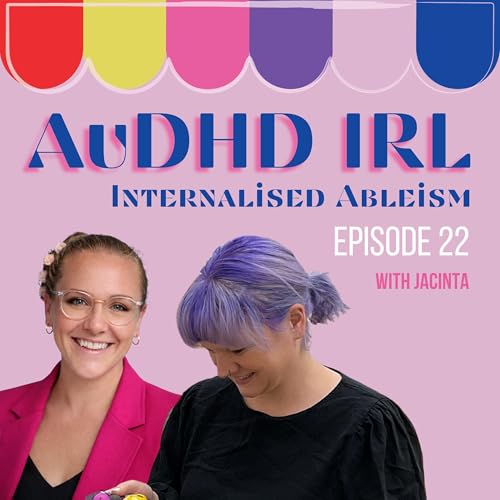
AuDHD IRL cover art

AuDHD IRL

AuDHD IRL

By: Bri Thomas
Listen for free

AuDHD IRL is a podcast about what it really looks like to be autistic + ADHD, beyond the hot takes and productivity hacks. Each episode feels like a cuppa with someone a few steps ahead on the journey (who’s tripped over it a few times). We talk honestly about it all, with laughter, tasteful swearing, and lots of self-compassion. This isn’t about fixing yourself. It’s about understanding your brain, finding language for your experience, and feeling less alone while you figure things out in real life. Come as you are. Stay as long as you like. From Ngunnawal and Ngambri lands/knowledge/love.Bri Thomas Personal Development Personal Success
Episodes
  • Ep23. AuDHD & Immigrant Realities with Sandhya Menon
    Jun 7 2026

    Bri sits down with Sandhya Menon, AuDHD developmental psychologist, author of The Brain Forest, The Rainbow Brain, and My Body's Power Pack, and one of Australia's most trusted voices in neurodivergent affirming practice. Together, they explore a topic that doesn't get nearly enough airtime: what it actually means to be AuDHD and an immigrant, and why the dominant narrative in neurodivergent spaces still has a long way to go.

    Sandhya shares her own story of moving from Singapore to Melbourne in 2007, arriving in winter without a coat, navigating racism, Australian slang, and a culture where "how you going?" felt like a rude question. She speaks candidly about what it took to settle her nervous system, how cultural context gets lost in clinical translation, and why her own ADHD diagnosis took three years because her presentation was misread as trauma.

    This conversation is warm, honest, and genuinely challenging in the best way.

    Key Takeaways

    • Cultural lens matters in assessment. Existing diagnostic frameworks carry assumptions that aren't universally applicable: that people are naturally help-seeking, that English fluency equals English thinking, that emotional expression looks the same across cultures. It often doesn't.
    • Compensation isn't masking. For many people from collectivist cultures, what looks like masking is actually deeply ingrained cultural expectation around family roles, hierarchy, and "saving face." These are not the same thing, and conflating them causes diagnostic blind spots.
    • Language doesn't just translate. Sandhya shares the example of garang, a word that captures fierceness rooted in love and discipline, something "anger" simply can't hold. When we lose the untranslatable, we lose context that matters clinically.
    • Notice before you fix. When discomfort arises, the instinct is to move to action. Sandhya invites us to pause, sit with it, and ask what the discomfort is trying to teach us before reaching for a solution or a statement.
    • Do the work. The resources already exist. Scroll back through the archives. Borrow diverse books from the library. Use the tools you already have. Asking marginalised people to educate you is labour. Doing the work first is respect.
    • Sharing power is a practice. Whether that's stepping aside from a speaking opportunity, buying extra conference tickets for people who can't afford it, or asking whose voice is actually needed in the room, equity is built in the everyday decisions.

    Find Sandhya: @onwardsandupwardspsych on InstagramBooks: The Brain Forest, The Rainbow Brain, My Body's Power Pack can be found at her website, www.onwardsandupwardspsychology.com.au.

    Show More Show Less
    45 mins
  • Ep22. AuDHD & Internalised Ableism with Jacinta
    May 23 2026

    Summary: Bri sits down with Dr Jacinta Thompson, clinical psychologist, AuDHDer, and director of Time to Untangle Clinical Psychology Services, for one of those conversations where you spend half the time laughing in recognition and the other half going "wait, that's been happening to me this whole time?"

    The topic is internalised ableism, which sounds like a very serious academic concept and is also the reason you spent twenty minutes yesterday beating yourself up for not being able to do a phone call. Jacinta breaks it down with the kind of clarity and warmth that only comes from someone who is both deeply trained in this space AND regularly hides inside her own dress at professional networking events. She's one of us.

    Together, Bri and Jacinta explore where internalised ableism actually comes from (spoiler: the world, not you), why it's so easy to compare your worst self to your best self and declare yourself a disaster, and what it looks like to function brilliantly in one context while completely falling apart in another. Jacinta shares some wonderfully honest personal examples, including what it's like to run a successful psychology practice while being completely unable to call the mechanic.

    There's also a genuinely useful thread about how to catch yourself in a "should" spiral, question where that rule came from, and figure out whether you've just been carrying it around like a bag of bricks that belongs to someone else. The takeaway is not "everything is fine." It's more like: you're not failing at life. You might just be a person with a nervous system, doing a remarkable job of making it work anyway.

    Key Takeaways

    1. Internalised ableism is absorbed, not invented. Societal messages about "normal" functioning get turned inward and eventually feel less like someone else's rule and more like a fact about who you are.
    2. Functioning is contextual, not global. Doing well in one setting doesn't mean you should do well everywhere. Context, structure, predictability and sensory environment all shape capacity enormously.
    3. We compare ourselves to ourselves, and that's its own trap. The gap between your "performing well" self and your "struggling" self isn't a character flaw. It reflects how different your capacity can be depending on what accommodations are in place.
    4. "What's wrong with me?" is the wrong question. When we can't meet an expectation, we tend to question ourselves rather than question the expectation. Asking "where did this rule even come from?" opens the door to a lot more self-compassion.
    5. Hidden disability means invisible cost. High-masking AuDHDers may look like they're coping, but there's often significant cost happening behind the scenes that others don't see and systems don't account for.
    6. Capacity changes over time and circumstance. Comparing your current functioning to a past version of yourself with fewer demands is neither fair nor useful. Capacity fluctuates, and that's not a failure.
    7. The tyranny of the shoulds is real. Those "I should just be able to..." thoughts are worth catching. Pressure is often a signal that someone else's should has landed on you as if it were yours.
    8. Ask "but why?" like a persistent five-year-old. Questioning the origin of a rule can reveal how arbitrary many norms actually are and make space for approaches that genuinely work for your brain.
    9. Diagnosis doesn't erase support needs. Being a psychologist or running a business does not mean you're not AuDHD. Functioning well in some areas can mask significant support needs in others.
    10. You're not lazy, flaky, or not trying hard enough. You might just be operating at capacity in a particular context. Curiosity and compassion, for yourself and for others, is where the real work begins.

    You can find Jacinta at her website: www.timetotheuntangle.com.au.

    Show More Show Less
    49 mins
  • Ep21. AuDHD, Pregnancy, Birth & Postpartum with Claire
    May 10 2026

    Content warning: This episode contains discussion of postpartum depression and anxiety, intrusive thoughts, and a brief reference to maternal mortality statistics. Please take care of yourself while listening.

    Summary:

    Bri sits down with Claire Britton, occupational therapist, university lecturer, founding director of Neuroinclusion, mum of two (nearly three) and proudly AuDHD, for a conversation that genuinely hasn't been had enough. Claire shares how she didn't receive her diagnosis until she was 28, and how it was the stillness of newborn life during COVID lockdown that finally made everything click. From there, the conversation opens up into the under-researched world of neurodivergence and the perinatal experience: why so many AuDHDers get diagnosed for the first time around pregnancy or postpartum, what sensory and executive functioning changes actually look like across trimesters, and why Claire (a self-described catastrophiser) genuinely loves giving birth. This one's warm, funny, practical and genuinely eye-opening.

    Takeaways:

    • Big life transitions (pregnancy, postpartum, puberty, perimenopause) are often when neurodivergence becomes impossible to ignore - not because something has gone wrong, but because the scaffolding that masked it has shifted.
    • Sensory sensitivity in pregnancy is one of the few times society validates and honours sensory differences without question. Claire uses this as a powerful entry point when educating parents about their children's sensory processing.
    • Many AuDHDers actually cope well with labour because it's predictable, time-limited and has a known outcome - it's the uncontrollable unknowns (like finding a car park) that are harder on the nervous system.
    • The relationship with your care provider matters more than the model of care. Safety, consistency and feeling genuinely understood are more therapeutic than any specific clinical approach.
    • Knowing your needs before you're in crisis (ideally written down) gives your support network something to actually work with. "I need to survive" is not a helpful answer in the moment, but you can get there ahead of time.
    • The stigma that neurodivergent people aren't equipped to be parents does real harm. For many, having children provides structure, purpose and motivation that genuinely improves their functioning.

    Find Claire on Instagram at @neuroinclusion.au, or search Neuroinclusion on Facebook and LinkedIn.

    Show More Show Less
    56 mins
adbl_web_anon_alc_button_suppression_t1
No reviews yet