

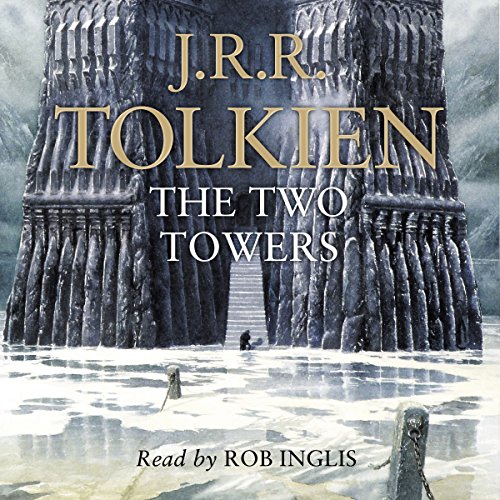
The Two Towers
The Lord of the Rings, Book 2
Failed to add items
Add to basket failed.
Add to wishlist failed.
Remove from wishlist failed.
Adding to library failed
Follow podcast failed
Unfollow podcast failed
3 Months Free

The Two Towers
Buy Now for £19.04
-
Narrated by:
-
Rob Inglis
-
By:
-
J. R. R. Tolkien
Building on the story begun in The Hobbit and The Fellowship of the Ring, this is the second part of Tolkien’s epic masterpiece, The Lord of the Rings.
Frodo and the Companions of the Ring have been beset by danger during their quest to prevent the Ruling Ring from falling into the hands of the Dark Lord by destroying it in the Cracks of Doom. They have lost the wizard, Gandalf, in the battle with an evil spirit in the Mines of Moria; and at the Falls of Rauros, Boromir, seduced by the power of the Ring, tried to seize it by force. While Frodo and Sam made their escape the rest of the company were attacked by Orcs.
Now they continue their journey alone down the great River Anduin – alone, that is, save for the mysterious creeping figure that follows wherever they go.
Critic reviews
‘Tolkien’s invention of strange peoples, curious incidents, miraculous doings, is poured out in this second volume of his trilogy as exuberantly and convincingly in a dreamlike way, as ever. As the story goes on the world of the Ring grows more vast and mysterious and crowded with curious figures, horrible, delightful or comic. The story itself is superb.’
Observer
‘Among the greatest works of imaginative fiction of the twentieth century.’
Sunday Telegraph
Featured article: Aragorn - a Lord of the Rings character guide
From his time as the ranger Strider to his ascension to King of Gondor, this guide has everything you need to know about the hero Aragorn. Perhaps one of the most mysterious and intriguing characters in the Lord of the Rings trilogy, Aragorn is known by many names: Strider, Elessar, Estel, and finally Aragorn II, heir to the throne of Gondor and Arnor. From a shadowy tracker who mysteriously comes to Frodo's aid to an essential member of the Fellowship of the Ring to the long-awaited king who restores harmony and peace to Middle-earth, Aragorn plays many important roles in the fantasy epic. And he has quite an interesting history.

The other day, I discovered something quite shocking when I watched the Peter Jackson film of the same name. Before I started these books I loved the films, every single one - quite prepared to row with my grown up children when they borrowed the (extended) dvds without asking.
I'm sorry Pete but I can't watch them now, without misgivings, the books have thoroughly spoiled me. Extended box sets - bah!! A lot of actors flashing pleasing faces and big, doleful eyes at you. Pah!
...Okay, the wargs are slavering and wicked scary and the olyphants are dazzling, prehistoric looking beasts! Not to mention I would do anything to fly on a giant eagle and give Shadowfax a sugar lump - I still love your animals, my man and your fighting uruk hai!
Oh, but give me sweet, tender, loyal Sam and stinking, clammy, malevolent Gollum and a terrain that I have walked barefoot in alongside Frodo (bearing that burden) any day.
What an epic
Something went wrong. Please try again in a few minutes.
It's a simple question of translation, really. Howard Goldblatt, who has translated many Chinese works into English, among them Mo Yan, once said in an interview that when one is reading Mo Yan in English, one is really reading Goldblatt. I think it saves me many a night's sleep to see this difference between one medium and another, and the problems of translation inherent in each.
The crossroads of "The Fellowship of the Ring" and "The Two Towers" is a very meaty moment for comparisons. Jackson decided to include the first chapter of this book in the first film despite also dwelling more on the Uruk-hai attack and Boromir's role in it. Tolkien on the other hand lets Frodo and Sam get away and end there. The very beginning is brilliant, the remaining members of the fellowship doing some detective work tracing the tracks.
Both solutions work, I think, since they are the two grand climaxes at the intersection of the two books. On one hand, it is Frodo's escape, Sam's loyalty and their friendship that will face almost certain death, just the two of them; on the other, it's the tragic effect the ring has to the world of men, their dominions pestered by orc attacks, and the growing influence of dark creatures in the land. Here again the two worlds, that of hobbits and of men, meet. Jackson's solution works in filmic terms because it sets in motion the two escapades that dominate the following films, but Tolkien's is more intimate to my mind, and the opening of "The Two Towers" is very powerful indeed.
As for the rest of the book, the highlight for me has always been the confrontation with Saruman. Although I understand the reasoning behind the film version in introducing Saruman so early in "The Fellowship of the Ring", in Tolkien it's dramatically a very powerful moment when we arrive at Isengard to confront him, since we've been hearing so much about him already. He's a compelling character more than anything else, and considering that his army has already been defeated and his Isengard is in ruins, he remains a threatening presence to the very end. It is, in some ways, an anticlimax, sure, to see him already in the jaws of defeat, and I remember longing to have seen him at the peak of his powers.
Other nice moments is especially the heist of the orcs, and the hobbits' sojourn through Fangorn, but I'm finding it very difficult to get fired up by the Rohan storyline, including the battle of Helm's Deep, which, thankfully, is not as detailed as in the films.
The story revolving around the Palantír is also brilliant, evocative literature. This is where Tolkien's route of keeping Saruman from us so far pays off doubly, since he hasn't had to reveal the Palantír's function to at all, not even mention the whole thing. It's a wonderful, mysterious object, and Pippin's descent into incurable and mad curiosity becomes deeper and so much more dangerous because we are not quite sure what the thing does.
The last paragraph is, as usual, devoted to Inglis. It's an admirable feat to keep such a narrative together with such a multitude of different characters. He makes it all sound so easy and natural, which itself is a task unimaginably difficult to pull off properly. A great narrator.
Off to Book IV!
Dealings With Wizards
Something went wrong. Please try again in a few minutes.
A book of two halves
Something went wrong. Please try again in a few minutes.
Incredible
Something went wrong. Please try again in a few minutes.
Improvement on the first
Something went wrong. Please try again in a few minutes.