

29 - World War II (1939–1945).
Failed to add items
Sorry, we are unable to add the item because your shopping cart is already at capacity.
Add to basket failed.
Please try again later
Add to wishlist failed.
Please try again later
Remove from wishlist failed.
Please try again later
Adding to library failed
Please try again
Follow podcast failed
Unfollow podcast failed

29 - World War II (1939–1945).
-
Narrated by:
-
By:
About this listen
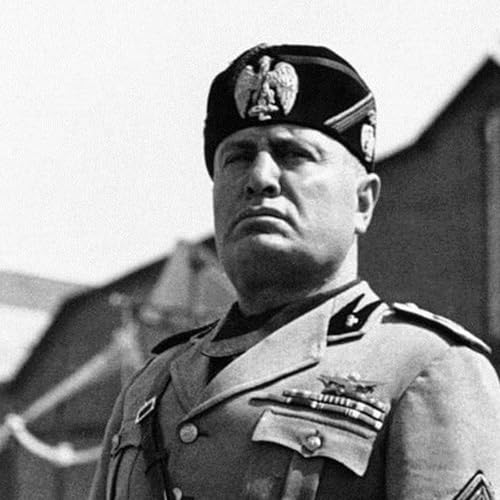
In Fascist Italy and Nazi Germany, both Mussolini and Hitler pursued territorial expansionist and interventionist foreign policy agendas from the 1930s through the 1940s culminating in World War II. From 1935 to 1939, Germany and Italy escalated their demands for territorial claims and greater influence in world affairs. Italy invaded Ethiopia in 1935 resulting in its condemnation by the League of Nations and its widespread diplomatic isolation. In 1936, Germany remilitarized the industrial Rhineland, a region that had been ordered demilitarized by the Treaty of Versailles. In 1938, Germany annexed Austria and Italy assisted Germany in resolving the diplomatic crisis between Germany versus Britain and France over claims on Czechoslovakia by arranging the Munich Agreement that gave Germany the Sudetenland and was perceived at the time to have averted a European war. These hopes faded when Czechoslovakia was dissolved by the proclamation of the German client state of Slovakia, followed by the next day of the occupation of the remaining Czech Lands and the proclamation of the German Protectorate of Bohemia and Moravia. At the same time from 1938 to 1939, Italy was demanding territorial and colonial concessions from France and Britain. In 1939, Germany prepared for war with Poland, but attempted to gain territorial concessions from Poland through diplomatic means. The Polish government did not trust Hitler's promises and refused to accept Germany's demands.
The invasion of Poland by Germany was deemed unacceptable by Britain, France and their allies, leading to their mutual declaration of war against Germany and the start of World War II. In 1940, Mussolini led Italy into World War II on the side of the Axis. During World War II, the Axis Powers in Europe led by Nazi Germany participated in the extermination of millions of Poles, Jews, Roma, Sinti and others in the genocide known as the Holocaust. In 1943, after Italy faced multiple military failures, the complete reliance and subordination of Italy to Germany, the Allied invasion of Italy and the corresponding international humiliation, Mussolini was removed as head of government and arrested on the order of King Victor Emmanuel III, who proceeded to dismantle the Fascist state and declared Italy's switching of allegiance to the Allied side. Mussolini was rescued from arrest by German forces and led the German client state, the Italian Social Republic from 1943 to 1945. Nazi Germany faced multiple losses and steady Soviet and Western Allied offensives from 1943 to 1945.
On 28 April 1945, Mussolini was captured and executed by Italian communist partisans. On 30 April 1945, Hitler committed suicide. Shortly afterwards, Germany surrendered and the Nazi regime was systematically dismantled by the occupying Allied powers. An International Military Tribunal was subsequently convened in Nuremberg. Beginning in November 1945 and lasting through 1949, numerous Nazi political, military and economic leaders were tried and convicted of war crimes, with many of the worst offenders being sentenced to death and executed.
Wikipedia: Text is available under the Creative Commons Attribution-ShareAlike 4.0 License.
This episode includes AI-generated content.
No reviews yet