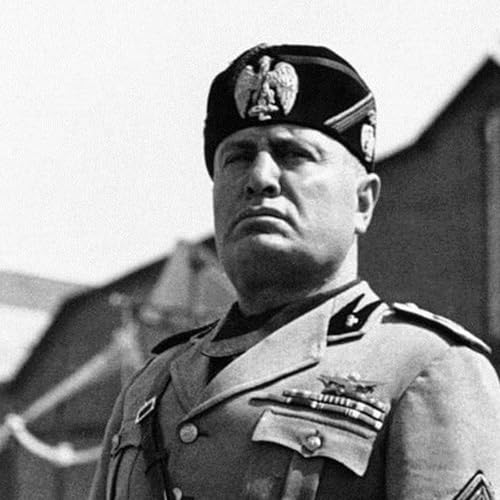
25 - Fascist Manifesto and Charter of Carnaro. cover art

25 - Fascist Manifesto and Charter of Carnaro.

25 - Fascist Manifesto and Charter of Carnaro.

Listen for free

View show details

About this listen

Fascist Manifesto and Charter of Carnaro. In 1919, Alceste De Ambris and futurist movement leader Filippo Tommaso Marinetti created "The Manifesto of the Italian Fasces of Combat". The Fascist Manifesto was presented on 6 June 1919 in the fascist newspaper Il Popolo d'Italia and supported the creation of universal suffrage, including women's suffrage (the latter being realized only partly in late 1925, with all opposition parties banned or disbanded); proportional representation on a regional basis; government representation through a corporatist system of "National Councils" of experts, selected from professionals and tradespeople, elected to represent and hold legislative power over their respective areas, including labour, industry, transportation, public health, and communications, among others; and abolition of the Senate of the Kingdom of Italy. The Fascist Manifesto supported the creation of an eight-hour work day for all workers, a minimum wage, worker representation in industrial management, equal confidence in labour unions as in industrial executives and public servants, reorganization of the transportation sector, revision of the draft law on invalidity insurance, reduction of the retirement age from 65 to 55, a strong progressive tax on capital, confiscation of the property of religious institutions and abolishment of bishoprics, and revision of military contracts to allow the government to seize 85% of profits. It also called for the fulfillment of expansionist aims in the Balkans and other parts of the Mediterranean, the creation of a short-service national militia to serve defensive duties, nationalization of the armaments industry, and a foreign policy designed to be peaceful but also competitive. The next events that influenced the fascists in Italy were the raid of Fiume by Italian nationalist Gabriele d'Annunzio and the founding of the Charter of Carnaro in 1920. D'Annunzio and De Ambris designed the Charter, which advocated national-syndicalist corporatist productionism alongside D'Annunzio's political views. Many fascists saw the Charter of Carnaro as an ideal constitution for a fascist Italy. This behaviour of aggression towards Yugoslavia and South Slavs was pursued by Italian fascists with their persecution of South Slavs—especially Slovenes and Croats. The Italians claimed Fiume on the principle of self-determination, disregarding the 50.4% of its population that were Yugoslavs. Accommodating conservatives. In 1920, militant strike activity by industrial workers reached its peak in Italy and 1919 and 1920 were known as the "Red Year" (Biennio Rosso). Mussolini and the fascists took advantage of the situation by allying with industrial businesses and attacking workers and peasants in the name of preserving order and internal peace in Italy. Fascists identified their primary opponents as the majority of socialists on the left who had opposed intervention in World War I. The fascists and the Italian political right held common ground: both held Marxism in contempt, discounted class consciousness and believed in the rule of elites. The fascists assisted the anti-socialist campaign by allying with the other parties and the conservative right in a mutual effort to destroy the Italian Socialist Party and labour organizations committed to class identity above national identity. Fascism sought to accommodate Italian conservatives by making major alterations to its political agenda—abandoning its previous populism, republicanism and anticlericalism, adopting policies in support of free enterprise and accepting the Catholic Church and the monarchy as institutions in Italy. To appeal to Italian conservatives, fascism adopted policies such as promoting family values, including policies designed to reduce the number of women in the workforce—limiting the woman's role to that of a mother. The fascists banned literature on birth control and increased penalties for abortion in 1926, declaring both crimes against the state. Although fascism adopted a number of anti-modern positions designed to appeal to people upset with the new trends in sexuality and women's rights—especially those with a reactionary point of view—the fascists sought to maintain fascism's revolutionary character, with Angelo Oliviero Olivetti saying: "Fascism would like to be conservative, but it will be by being revolutionary." The Fascists supported revolutionary action and committed to secure law and order to appeal to both conservatives and syndicalists. Prior to fascism's accommodations to the political right, fascism was a small, urban, northern Italian movement that had about a thousand members. After Fascism's accommodation of the political right, the fascist movement's membership soared to approximately 250,000 by 1921. A 2020 article by Daron Acemoğlu, Giuseppe De Feo, Giacomo De Luca, and Gianluca Russo in the Center for Economic and Policy Research, exploring the link between the threat ...
No reviews yet